Classicism1645
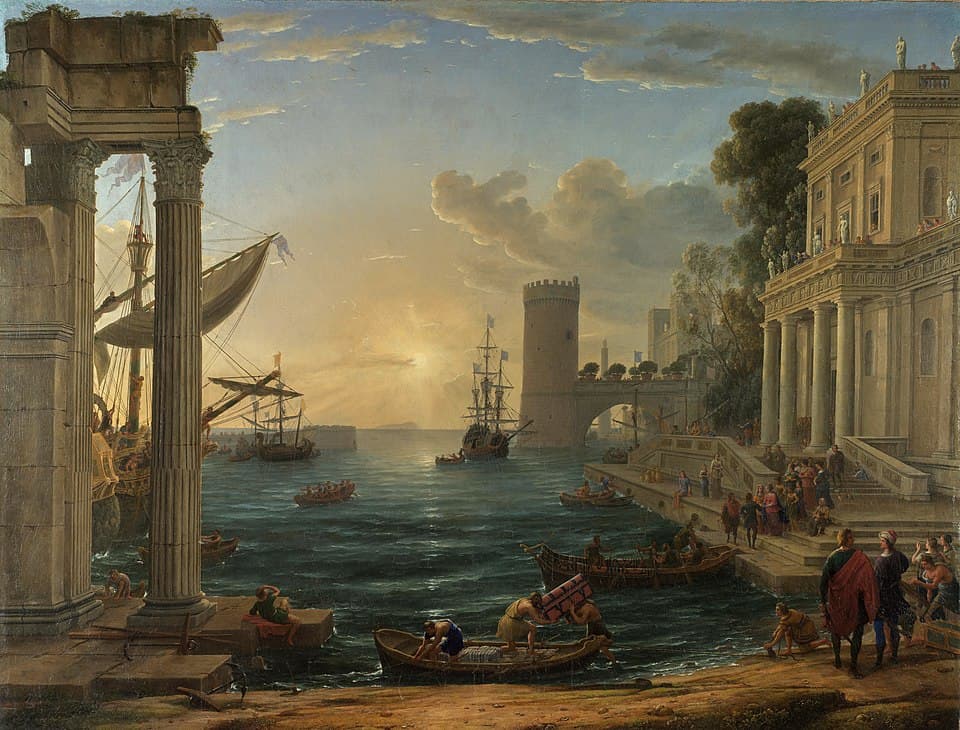
Coast Scene with Apollo and the Cumaean Sibyl
Claude Lorrain
Curator's Eye
"Claude Lorrain here elevates the classical landscape by integrating grandiose ancient ruins that emphasize the melancholy of passing time against nature's immutable splendor."
An idyllic landscape where the golden light of sunset envelops a muted tragedy: that of eternal life requested without eternal youth.
Analysis
The work depicts a fateful encounter from Ovid's Metamorphoses. Apollo, the god of light and poetry, is enamored with the Cumaean Sibyl. To seduce her, he offers to grant her a wish. The Sibyl picks up a handful of sand and asks to live as many years as there are grains in her hand. However, she forgets to ask for eternal youth. Apollo grants her wish, but because she refuses his advances, he allows her to age until she becomes a disembodied voice trapped in a jar.
To truly understand what we see, one must observe the interaction between the two tiny figures against the vastness of the setting. The Sibyl, still young and beautiful in this scene, holds out her hand to the god, unaware that her wish contains her own doom. Lorrain uses this myth to meditate on human fragility in the face of the eternity of the elements. The landscape is not a mere backdrop; it is the silent witness to the vanity of mortal desires, where stone crumbles while light persists.
Expert analysis highlights that Lorrain does not seek historical accuracy in the ruins, but an "Arcadian" atmosphere. The remnants of Roman architecture in the foreground serve as a memento mori: even the greatest civilizations turn to dust, just as the Sibyl will eventually wither away. Light, the true protagonist of the canvas, unifies the sky, sea, and land in an atmospheric blend of which Lorrain alone holds the secret.
Finally, this work marks the pinnacle of the "ideal landscape." Unlike the tormented landscapes of the North, Lorrain offers an ordered, almost musical vision of nature. Every tree and column is placed with mathematical precision to guide the eye toward the infinite horizon. It is a painting of contemplation where time seems suspended, capturing the precise moment when divine negotiation seals a tragic fate within a setting of absolute beauty.
Join Premium.
UnlockQuiz
What gift does Apollo grant to the Sibyl in exchange for her love?
Discover