Neoclassicism1810
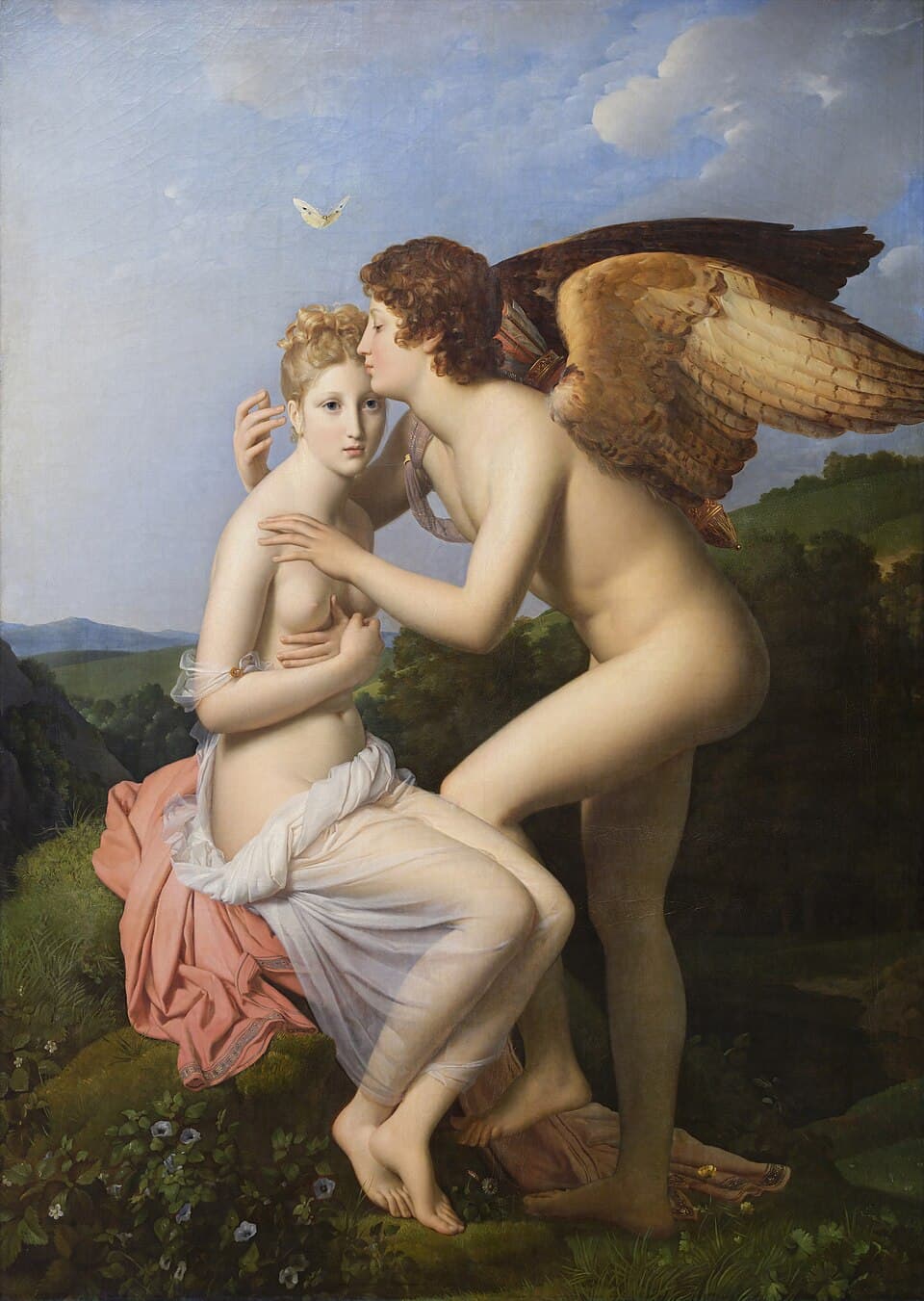
Aurora and Cephalus
Pierre-Narcisse Guérin
Curator's Eye
"The goddess's ethereal levitation, the sculptural body of Cephalus in deep sleep, and the winged Cupid linking two worlds."
A peak of sensual Neoclassicism depicting Aurora's rapture for the mortal Cephalus, an icon of First Empire elegance.
Analysis
Pierre-Narcisse Guérin’s work, presented at the 1810 Salon, represents a pivotal shift from the austere Neoclassicism of Jacques-Louis David toward a more fluid, poetic aesthetic. Inspired by Ovid’s Metamorphoses, the painting portrays Aurora (Eos), the goddess of the Dawn, falling in love with the hunter Cephalus. Guérin captures the precise moment of silent seduction, as the divinity descends from the heavens to snatch the young man from his earthly rest. This thematic choice reflects a period of artistic transition where heroic rigor gave way to an exploration of grace and intimacy.
Stylistically, Guérin employs an exceptionally fine modeling technique, giving the skin a porcelain-like appearance that seems to radiate its own light. The treatment of the light, transparent draperies accentuates the effect of miraculous suspension. The historical context of the Empire favored a return to the ideal of ancient beauty, but Guérin injected a pre-Romantic melancholy into it. The pearly tones and soft chromatic transitions demonstrate an absolute mastery of glazing, creating a dreamlike atmosphere where time seems to stand still.
The mythological narrative contains a tragic depth beneath its apparent serenity: this abduction would eventually lead to the downfall of Procris, Cephalus’s wife, through jealousy and doubt. However, Guérin chooses to depict the apotheosis of beauty instead. The work’s psychology rests on the contrast between the goddess’s active will and the mortal’s passive surrender. Cephalus, in his sleep, becomes the object of an irresistible divine desire, reversing traditional codes of romantic conquest. His statuary nudity symbolizes a vulnerable purity in the face of immense celestial destiny.
Technical analysis highlights the influence of Antonio Canova’s sculpture, whose search for the "ideal beauty" is mirrored in Aurora’s sinuous silhouette. Guérin uses a diffused light source from the horizon to sculpt forms without creating harsh shadows. This light symbolizes the awakening of consciousness and nature, as well as the intrusion of the sacred into the profane world. The work thus becomes a visual meditation on the encounter between divine eternity and human finitude, a theme cherished by the intellectual elite of the Imperial era.
Join Premium.
UnlockQuiz
Which technical aspect of this work particularly fascinated critics in 1810?
Discover