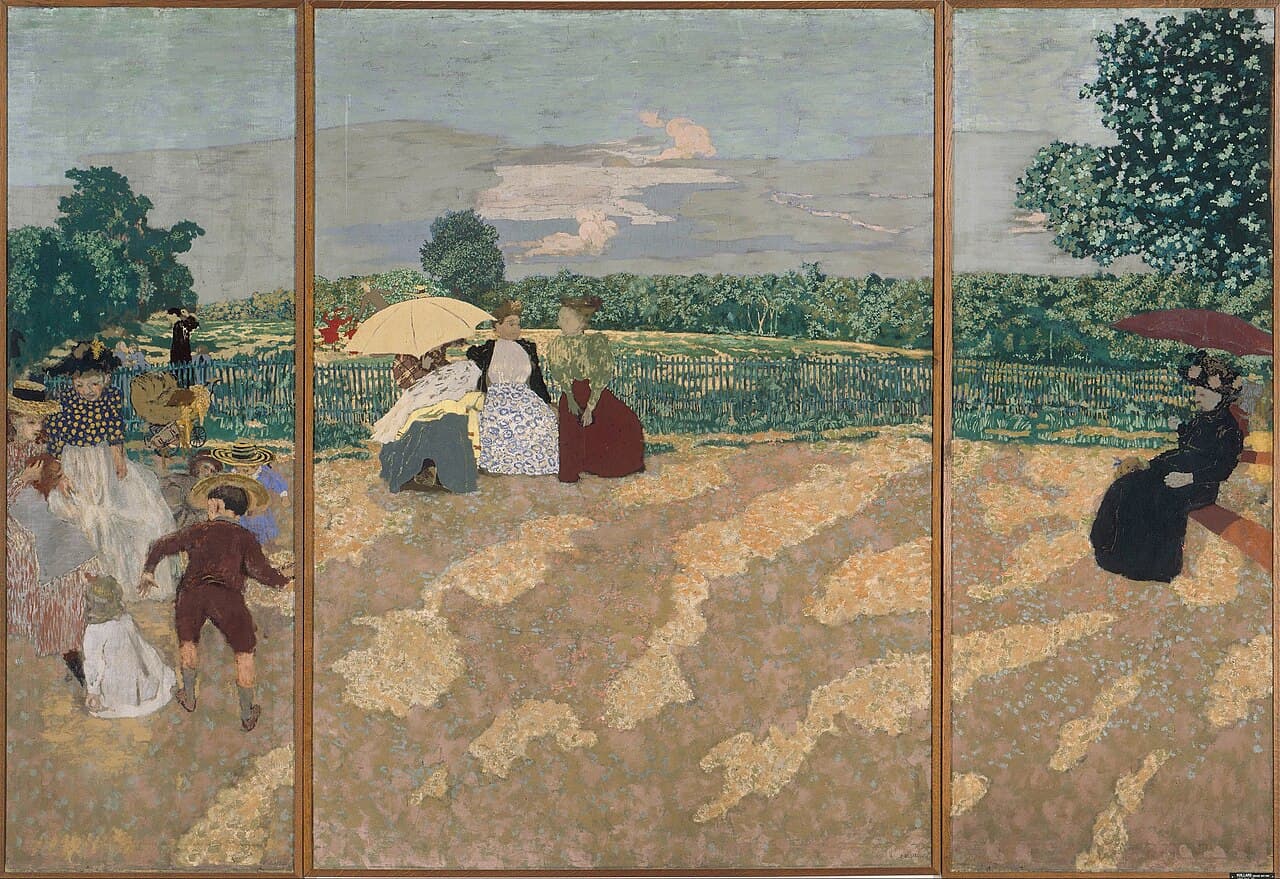
Post-Impressionism1913
Dining Room in the Country
Pierre Bonnard
Curator's Eye
"The work is distinguished by its bold framing: the gaping opening of the French window becomes the central subject, transforming the landscape into a painting within a painting. The striking contrast between deep reds and acidic greens creates exceptional tension."
A true chromatic explosion, this 1913 masterpiece captures the moment when outdoor light floods the domestic space. Bonnard sublimates daily life by merging the interior of his villa "Ma Roulotte" with the luxuriance of the Norman garden.
Analysis
Dining Room in the Country marks a crucial milestone in Pierre Bonnard's maturity. Painted in Vernonnet, in his house nicknamed "Ma Roulotte", the work testifies to his definitive break with Nabi dogma in favor of a pure exploration of colored sensation. Here, Bonnard does not paint a place, but the memory of a visual emotion. The French window, a recurring motif in his work, serves as a metaphysical threshold between two worlds: the ordered comfort of the bourgeoisie and the indomitable force of nature. Marthe, his eternal muse, leans by the window, creating a human bridge between these two spheres.
The deep analysis reveals a work on light that is no longer Impressionist. Unlike Monet who chased the fleeting moment, Bonnard reconstructs light in the studio from his notes and memory. This light is not directional; it seems to spring from the canvas itself. The reds of the wall and the tablecloth are not just pigments; they are vectors of heat that oppose the cool breeze of the garden. It is a painting of total immersion where the air feels palpable, charged with colored particles.
The dialogue between the interior and the exterior is orchestrated with rare complexity. The window is not a simple cut, but an exchange zone. The reflections on the glass, the colored shadows cast on the sideboard, and the way the green of the garden seems to "contaminate" domestic objects illustrate Bonnard's pantheistic vision. For him, everything is a subject for painting, from a simple sugar bowl to the majesty of Norman trees. This equality of treatment between object and landscape is one of his major contributions to modern art.
Marthe's character, although in the background, is essential to the emotional charge of the work. She is not a portrait in the classic sense, but a familiar, almost spectral presence that inhabits the space. Her silhouette merges chromatically into the decor, reinforcing this idea of universal harmony. Bonnard explores "intimism" here not as an enclosure, but as a dilation of the self into the environment.
Finally, the work foreshadows the great decorations of the end of his life. The monumentality of the format and the boldness of the color juxtapositions (red, blue, yellow, green) herald the research of Rothko or Matisse on the autonomy of color. Bonnard proves here that painting can be both figurative in its subject and totally abstract in its plastic force, making this dining room a sacred space dedicated to vision.
Join Premium.
UnlockQuiz
What conceptual innovation in the management of pictorial space does Bonnard apply here to translate his theory of the "seduction of sight"?
Discover