Classicism1642
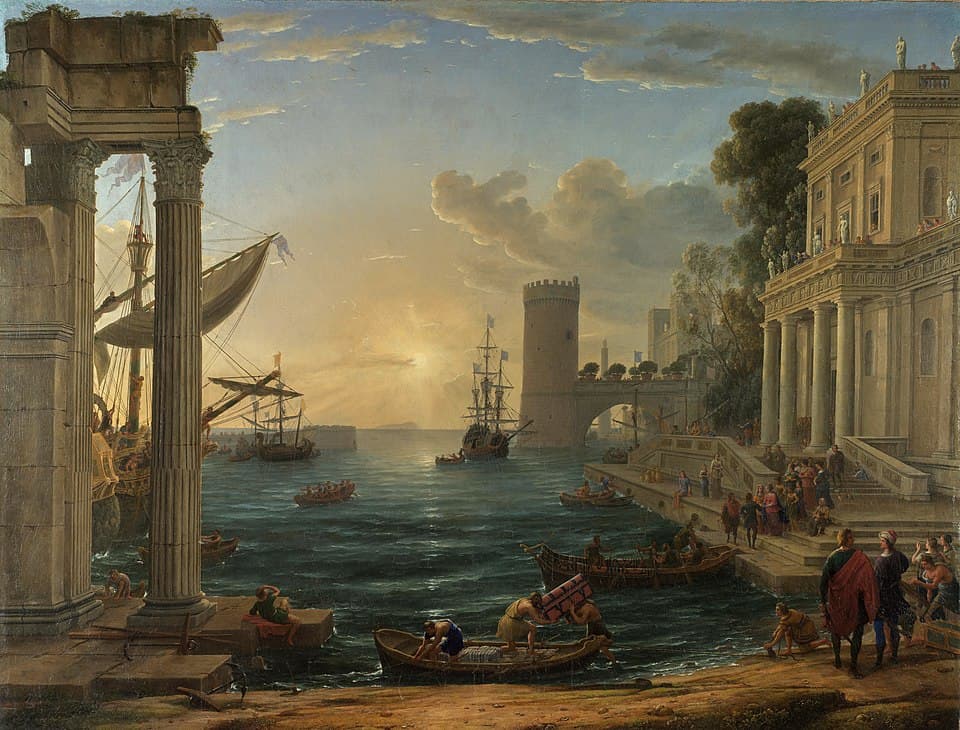
The Disembarkation of Cleopatra at Tarsus
Claude Lorrain
Curator's Eye
"Cleopatra emerges from her golden galley to be welcomed by Mark Antony on a monumental quay. The true subject is the setting sun irradiating the harbor, flanked by anachronistic palaces."
A masterpiece of classical landscape, this 1642 canvas sublimes the historical meeting between Cleopatra and Mark Antony through transcendent sunlight and grandiose imaginary architecture.
Analysis
Painted in Rome in 1642, "The Embarkation of Cleopatra" illustrates the quintessence of Claude Lorrain's style: the ideal landscape. Unlike traditional history painters, Lorrain was not interested in the archaeological veracity of ancient Egypt, but in creating a visual harmony between man and nature. The historical context is that of 17th-century papal Rome, where the aristocracy relished these nostalgic views of a dreamed Antiquity. The technique of "contre-jour" (backlighting), of which Lorrain is the absolute master, allows the entire scene to be unified under a sheet of golden light that dissolves contours and creates an atmosphere of melancholic serenity, typical of French classicism exported to Italy.
On a mythological and historical level, the work recounts the meeting at Tarsus in 41 BC. Cleopatra, seeking to seduce Mark Antony to ensure the independence of her kingdom, arrives on a ship with silver oars and purple sails. Lorrain interprets this Plutarch narrative by transposing it into a setting of Renaissance Roman palaces. This temporal shift emphasizes that the "myth" here is not just political, but aesthetic: it is the elevation of nature to the rank of a theater for human nobility. The figure of the queen, although central to the title, is treated with relative discretion, almost absorbed by the luminous immensity of the harbor.
Lorrain's technique relies on the superposition of extremely fine glazes. To achieve this solar brilliance, he used pigments such as Naples yellow and lead white, worked in successive layers to simulate the depth of air (atmospheric perspective). The details of the ships' rigging and the sculptures of the palaces are rendered with almost miniature precision, contrasting with the fluidity of the water and the evanescence of the sky. This duality between architectural rigor and atmospheric suppleness gives the work a unique poetic tension, where time seems suspended in the amber of the sunset.
Psychologically, the work radiates a sense of "nostalgia for the infinite." The viewer is invited to look not at the characters in the foreground, but toward the distant horizon where the sun touches the water. This invitation to a spiritual journey is the heart of Lorrain's approach. The majestic order of the palaces reassures the mind, while the openness toward the open sea releases the imagination. It is a work of pure contemplation that soothes human passions through the contemplation of cosmic order, transforming an episode of power and seduction into a meditation on eternal light.
Join Premium.
UnlockQuiz
What is the real central subject of Claude Lorrain's paintings?
Discover