Cubism1911
Tea Time
Jean Metzinger
Curator's Eye
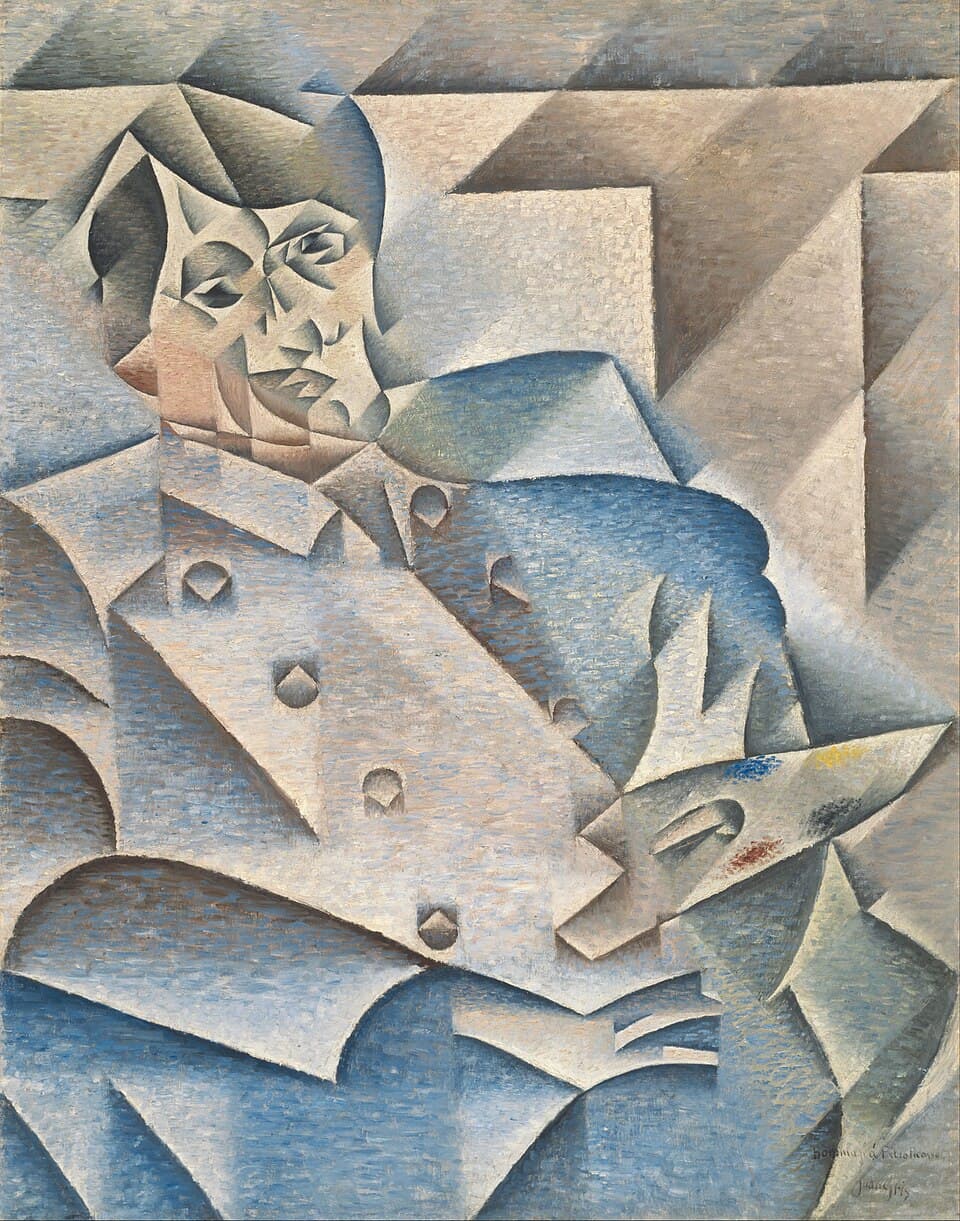
"A half-length nude woman holds a spoon above a cup of tea, illustrating the simultaneity of viewpoints. The viewer simultaneously observes the profile and the top of the cup, a major visual revolution."
Dubbed "The Mona Lisa of Cubism," this 1911 masterpiece marks the exact moment when Cubist deconstruction became legible and theorized. It merges a classic genre scene with a radical fragmentation of space.
Analysis
Painted in 1911 and exhibited at the Salon d'Automne, this canvas is one of the most important works of "Salon Cubism." Jean Metzinger, who was as much a theorist as a painter, applied the concepts he developed with Albert Gleizes in their book "Du Cubisme." The central idea is to break with the single perspective inherited from the Renaissance to introduce the temporal dimension: the artist moves around his subject and renders several facets on a fixed plane.
The work retains an elegance and legibility that distinguish it from the more austere and hermetic Cubism of Picasso or Braque at the same time. The female figure, although fragmented, remains sensual and identifiable, which allowed the general public and critics of the time to grasp the visual grammar of the movement for the first time. It represents a "civilized" form of Cubism, where geometrization does not totally sacrifice the beauty of the subject.
Metzinger integrates here a reflection on non-Euclidean geometry and the fourth dimension, subjects that fascinated the intellectual circles of Puteaux. The division of forms into crystalline facets creates a network structure that links the figure to the background. We are no longer in a window open to the world, but in a mental reconstruction of the object where visual memory plays a predominant role.
The choice of subject—a woman drinking tea—is a deliberate nod to the tradition of French genre painting. By reinterpreting this banal theme through the prism of the most radical modernity, Metzinger asserts that Cubism is not a break with art history, but its logical evolution. It is a visual manifesto proclaiming that reality can no longer be captured by a single, immobile gaze.
Join Premium.
UnlockQuiz
On which philosophical and technical concept is the simultaneous representation of the teacup (viewed from the side and the top) based in this work?
Discover