Classicism1652
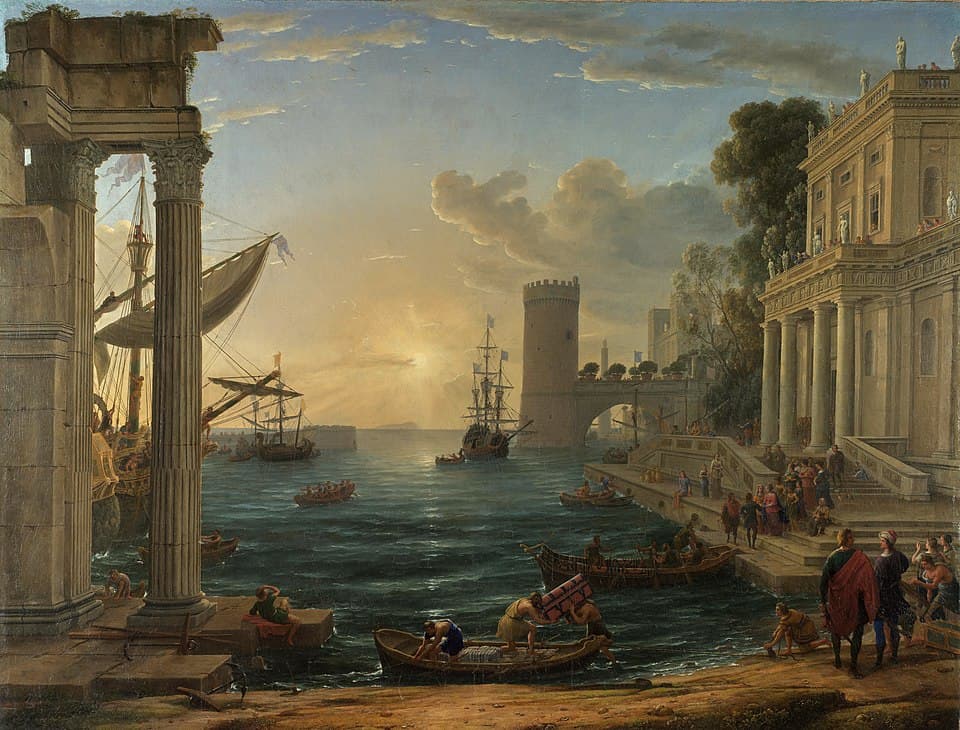
Landscape with Apollo and the Muses
Claude Lorrain
Curator's Eye
"Observe the exceptional rendering of atmospheric light on the horizon, a Lorrain signature that manages to make the air itself feel palpable and sacred."
An ideal vision of universal harmony where the god of arts presides over a landscape bathed in divine light. This is the pinnacle of French classical landscape, blending pastoral serenity with mythological nobility.
Analysis
This monumental work, painted for Cardinal Camillo Pamphili, represents Mount Parnassus, the sacred domain of Apollo. The god sits at the center, playing his lyre, surrounded by the nine Muses who personify the arts and sciences. At the foot of the mountain, the Castalian spring gushes forth, symbolizing poetic inspiration. Lorrain does not merely illustrate a myth; he creates a world where nature is in perfect harmony with the divine order, an eternal Arcadia where chaos is banished in favor of absolute clarity.
The myth of Apollo on Parnassus is used here to celebrate the patron's role as a protector of the arts. In Greek mythology, Parnassus is the gathering place for creative spirits, and Apollo, as the leader of the Muses' choir (Musagetes), maintains the balance between passion and reason. The presence of the Muses—from Calliope to Terpsichore—suggests that all human knowledge flows from this divine harmony, magnified by the majesty of a wild yet ordered nature.
Technical analysis reveals the revolutionary use of glazes to create this infinite spatial depth. Lorrain was the first to paint facing the sun, integrating the light source directly into the narrative structure. This light does not just illuminate the characters; it emanates from the distance like a metaphysical promise, transforming the landscape into a spiritual experience. The trees serve as theatrical wings, framing the divine to guide the eye toward the essential.
The work belongs to a period of maturity where Claude Lorrain abandons anecdotal details for epic grandeur. The figures, though small compared to the vastness of the setting, possess a statuary dignity. The dialogue between the craggy rocks and the softness of the water reflects the duality of the world: the immutable strength of the earth and the constant flow of creative inspiration. It is a meditation on the permanence of Beauty in the face of the passage of time.
Finally, this painting is a manifesto of the so-called "historical landscape." It proves that landscape can equal history painting in nobility and intellectual complexity. Every element, from the deer drinking to the misty peaks, contributes to a moral reading of the world: nature is not a simple backdrop, but the temple of a higher wisdom that only art can reveal.
Join Premium.
UnlockQuiz
What major technical innovation, characteristic of Lorrain's maturity, structures the metaphysical dimension of this landscape?
Discover