Classicism1644
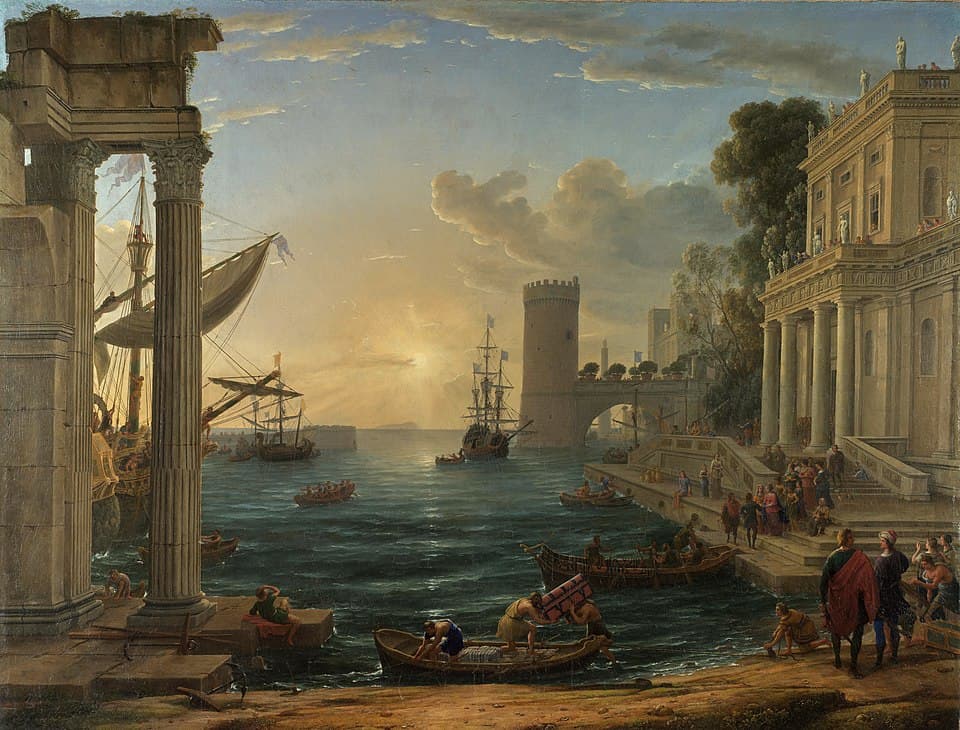
Ulysses Delivering Chryseis to her Father
Claude Lorrain
Curator's Eye
"The majestic port bathed in golden light, Ulysses escorting Chryseis to the priest Chryses, and the anachronistic architecture inspired by the Roman Renaissance."
A pinnacle of the classical ideal landscape where the harmony of solar light magnifies an episode from the Iliad, celebrating the return to order and piety.
Analysis
Painted around 1644, this canvas belongs to the golden age of French classicism, although produced in Rome where Lorrain spent his career. The work illustrates a crucial passage from the first book of Homer's Iliad: to appease Apollo's wrath, Agamemnon must return Chryseis to her father, the priest Chryses. Ulysses is charged with this diplomatic mission. The historical context reflects the 17th-century aspiration for a domesticated nature, ordered by reason, where Antiquity serves as a moral and aesthetic model.
Lorrain's style, the "ideal landscape," seeks a poetic truth rather than topographical accuracy. His technique relies on the layering of transparent glazes to capture the very essence of atmospheric light. Unlike his contemporaries who favored dramatic action, Lorrain subordinates human events to the vastness of the natural and architectural setting. The psychology here is one of appeasement: after the chaos of plague and conflict, the return of the young woman marks the reconciliation between men and gods.
The myth of Chryseis is intrinsically linked to the structure of heroic destiny. By returning the captive, Ulysses does not only perform a political gesture; he restores the cosmic balance broken by Agamemnon's hubris. Lorrain uses architecture as a metaphor for civilization. The palaces lining the port, though reminiscent of Bramante's Rome, symbolize the permanence of classical order. It is a nostalgic vision where the mythical past is reinvented to offer a contemplative refuge for the viewer's soul.
The deep analysis shows an unprecedented mastery of aerial perspective. The masts of the ships, the silhouettes of sailors, and the details of the colonnades gradually fade into a golden haze, creating infinite depth. Nature and architecture merge in perfect balance, where the shadow of the buildings in the foreground acts as a foil to accentuate the brilliance of the setting sun. It is a work that celebrates found peace and the grandeur of sovereign nature.
Join Premium.
UnlockQuiz
What is the main characteristic of the light in this Claude Lorrain painting?
Discover