Renaissance1538
Venus of Urbino
Titian
Curator's Eye
"The provocative direct gaze, the small dog symbolizing fidelity, and the spatial division between the intimate foreground and domestic background."
The peak of sophisticated Venetian Renaissance eroticism, transforming the mythological nude into a domestic allegory of fidelity and sensuality.
Analysis
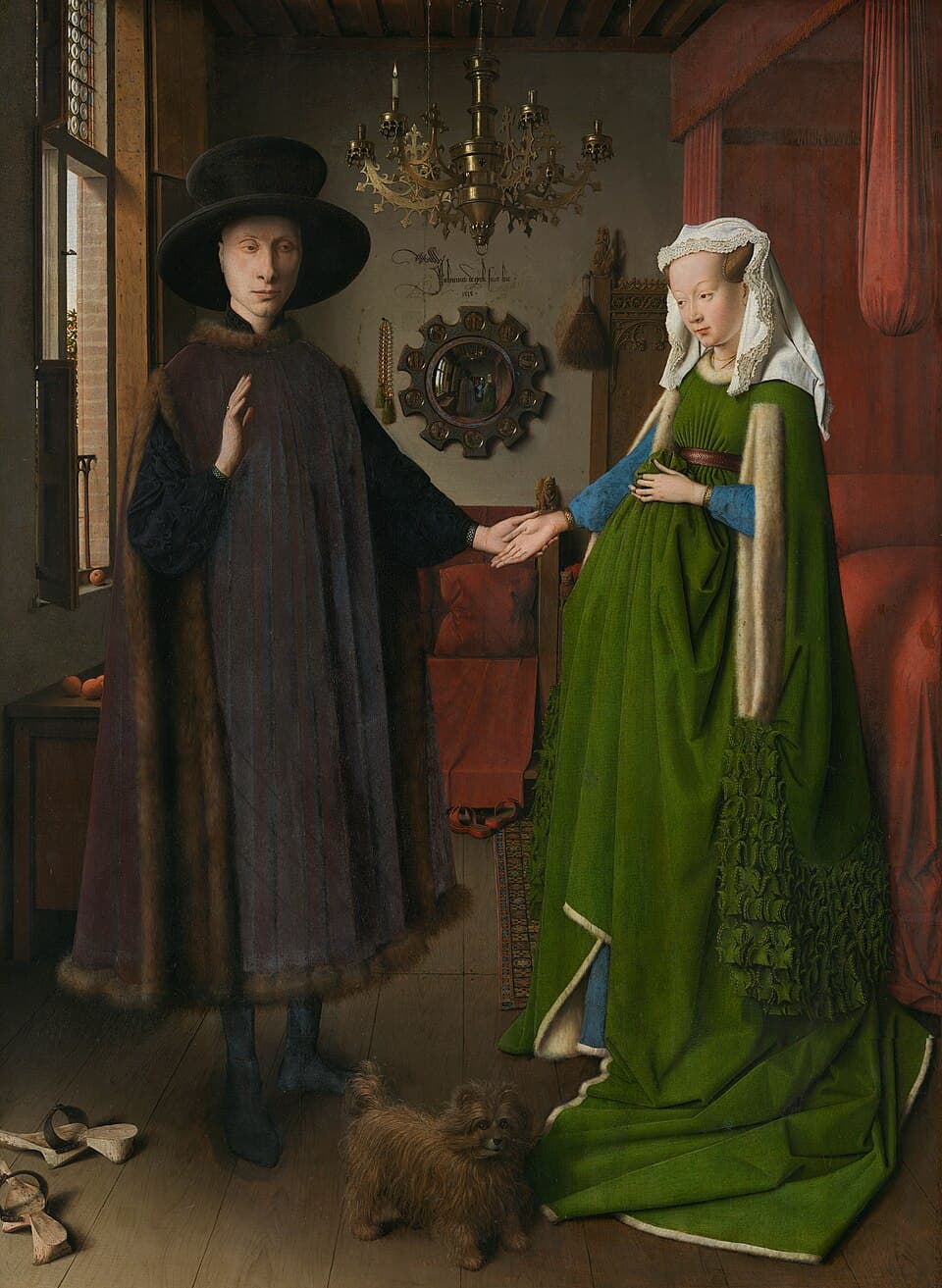
The Venus of Urbino, painted by Titian in 1538 for Guidobaldo II della Rovere, Duke of Urbino, marks a fundamental shift in the history of the nude. Unlike Giorgione's Sleeping Venus, this woman is awake, conscious of her beauty and her power of seduction. She is not in an Arcadian landscape, but in the intimacy of a 16th-century Venetian palace. The historical context is that of an opulent Venice where painting became the vehicle for celebrating earthly pleasures and aristocratic diplomacy, the work likely having been offered as a model of marital eroticism to the Duke's young wife.
Technically, Titian uses his legendary mastery of "colorito" here. The rendering of the skin is achieved through the layering of numerous translucent glazes, creating a depth and warmth that mimics life itself. The contrast between the brilliant white of the sheets, the deep red of the couch, and the dark green of the wall hanging irresistibly directs the eye toward the golden nudity of the central figure. The psychology of the work rests on the ambiguity of the gaze: the woman fixes the viewer with a quiet assurance, breaking the "fourth wall" and transforming the voyeur into an active participant in a scene of disturbing intimacy.
On a mythological level, although named "Venus" by posterity, the work is deeply rooted in domestic reality. The symbols present—the small dog sleeping at the foot of the bed (traditional symbol of marital fidelity), the myrtle flowers she holds in her right hand (sacred to Venus but also linked to marriage), and the servants in the background attending to the marriage chests (cassoni)—suggest that this work is a lesson in sensuality within the matrimonial union. It is a fusion between the eternal deity and the mortal wife, a sacralization of human desire.
The deep analysis also reveals a political and social dimension. At that time, the female nude was often used to demonstrate the wealth and cultural refinement of a court. Titian manages to balance erotic provocation with a strict formal elegance. The left hand of the Venus, placed with suggestive modesty, recalls the ancient "Venus Pudica," but the modern context transforms this gesture into an affirmation of the possession of her own body. It is a work that breathes the confidence of an era where men and women became the centers of a universe of pleasures and symbols.
Join Premium.
UnlockQuiz
What animal is sleeping at the foot of the bed, symbolizing fidelity?
Discover