Antiquity-100
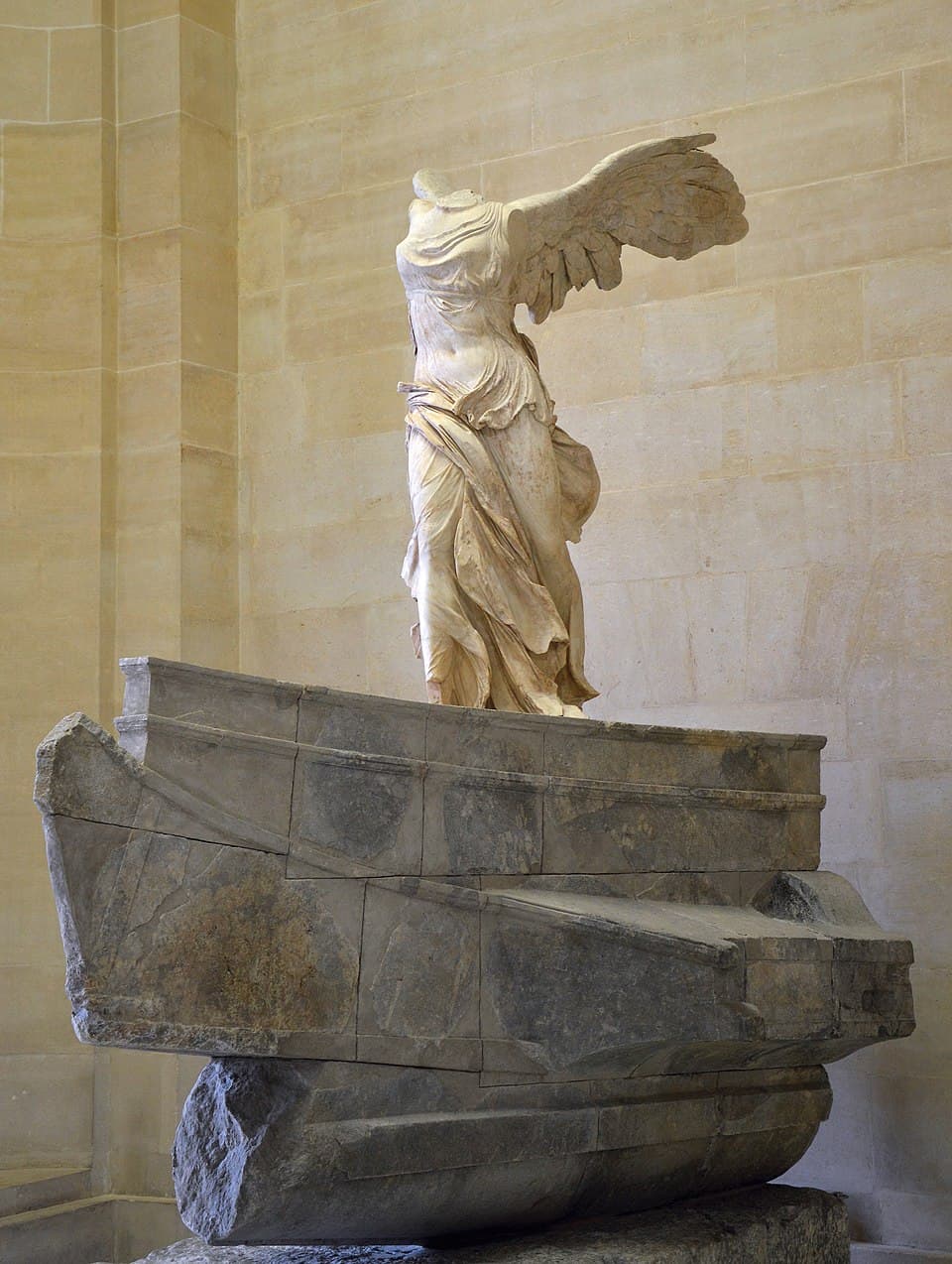
Venus de Milo
Unknown
Curator's Eye
"The twisting of the torso (contrapposto), the drapery slipping over the hips, and the enigma of the missing arms."
The absolute icon of classical beauty, blending the 4th-century BC ideal with Hellenistic innovation in sublime Parian marble.
Analysis
The Venus de Milo, discovered in 1820 on the island of Milos, is a pivotal work embodying the transition between serene classicism and tormented Hellenism. Although inspired by 4th-century models of Aphrodite, notably those by Praxiteles, it actually dates from the late Hellenistic period (c. 100 BC). This period is characterized by a return to classical forms, but with a new sensuality and dynamism. The historical context is that of Greece under Roman domination, seeking to reinvent its glorious past while satisfying collectors' taste for the spectacular.
Technically, the statue is a feat of assembly. Contrary to popular belief, it was not carved from a single block of Parian marble, but composed of several elements carved separately: the torso, legs, arms, and left foot were fixed with iron dowels. This method allowed for greater freedom of movement and optimized management of precious materials. The rendering of the flesh, almost supple under the gaze, contrasts sharply with the deep and heavy folds of the drapery that seems on the verge of falling, creating a unique erotic and psychological tension.
On a mythological level, the work represents Aphrodite, the goddess of love born from the foam. However, the absence of attributes makes interpretation complex: is she Amphitrite, the sea goddess worshipped in Milos, or a Victory holding a shield? The psychology of the work lies in her distant gaze and impassive face, which contrasts with the complex twisting of her body (the "figura serpentinata"). She exudes an aura of distant majesty, a deity who offers herself to the gaze while remaining inaccessible in her stony silence.
The work's impact on art history is incalculable. Upon its arrival at the Louvre, it was presented as a masterpiece of Greek classicism to compensate for the loss of the Belvedere Apollo (returned to Italy). This "invention" of an icon shaped our perception of ancient beauty. The balance between athletic structure and the softness of feminine curves makes it a living treatise on the harmony of opposites, a meditation on the permanence of the ideal through the fragments of history.
Join Premium.
UnlockQuiz
What physical characteristic is most famously missing from this ancient statue?
Discover