Abstract Art1923
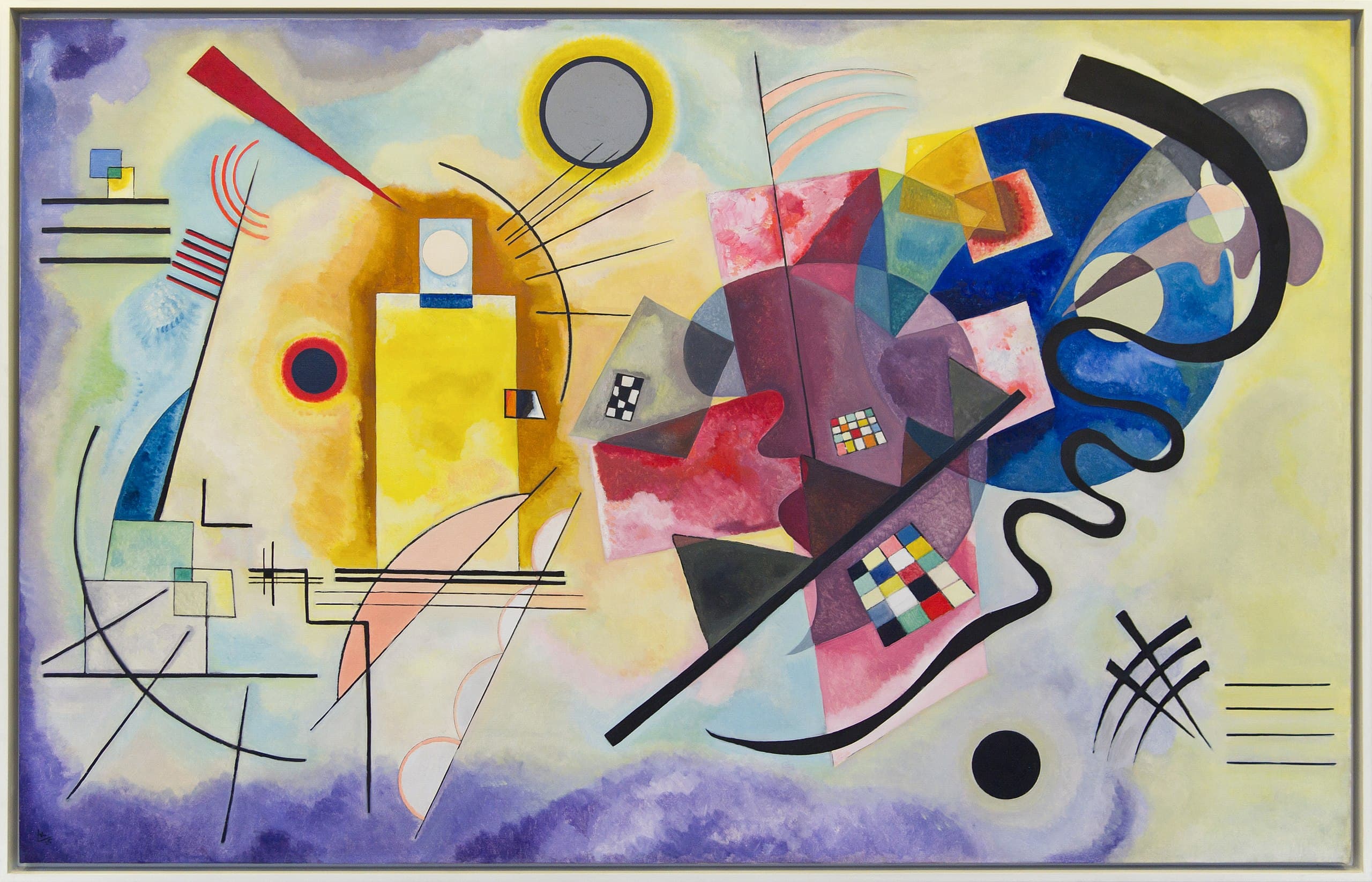
Composition VIII
Wassily Kandinsky
Curator's Eye
"Kandinsky abandons organic lyricism for a universal language of circles, triangles, and lines, creating a visual symphony where every angle corresponds to a specific psychological note."
An absolute masterpiece of geometric abstraction, this canvas marks the pinnacle of Kandinsky's Bauhaus period, where mathematical rigor meets the spiritual vibration of forms.
Analysis
Composition VIII represents Kandinsky's definitive transition to a "cold" and structured abstraction, influenced by his teaching at the Bauhaus. For the artist, this work was the most important of his mature period, as it concretized his theory of the correspondence between sounds and colors. It is not a random arrangement, but a quest for internal balance, an attempt to represent cosmic order through pure geometric shapes. Each element is a living entity endowed with an internal "tension."
The explanation of the "synesthesia" myth is fundamental here: Kandinsky "heard" colors and "saw" sounds. For him, the circle is not just a shape; it is a deep, stable sound, a window to the spiritual. The triangle, conversely, is an aggressive, yellow shape that points toward the future. This canvas is thus a silent musical score. Kandinsky believed that abstract art could act directly on the human soul, without passing through the barrier of recognizing real objects.
The work also reflects the intellectual climate of the time, marked by advances in physics and Gestalt psychology. Kandinsky sought to create a rational visual language capable of expressing the irrational. The space of the canvas is no longer a window on the world, but a field of dynamic forces where gravity no longer exists. Shapes float in an ethereal space, suggesting a metaphysical dimension beyond physical matter.
Finally, this work is a testament to the artist's faith in the progress of humanity. After the trauma of World War I and the Russian Revolution, Kandinsky proposes an art of reconstruction. The rigor of Composition VIII is a bulwark against the chaos of the outside world. It is an architecture of the spirit, a solid structure built on eternal geometric truths, aiming to elevate the viewer to a state of superior contemplation.
Join Premium.
UnlockQuiz
What major influence marks the rigid geometric style of this work compared to Kandinsky's earlier compositions?
Discover