Abstract Art1925
Yellow-Red-Blue
Wassily Kandinsky
Curator's Eye
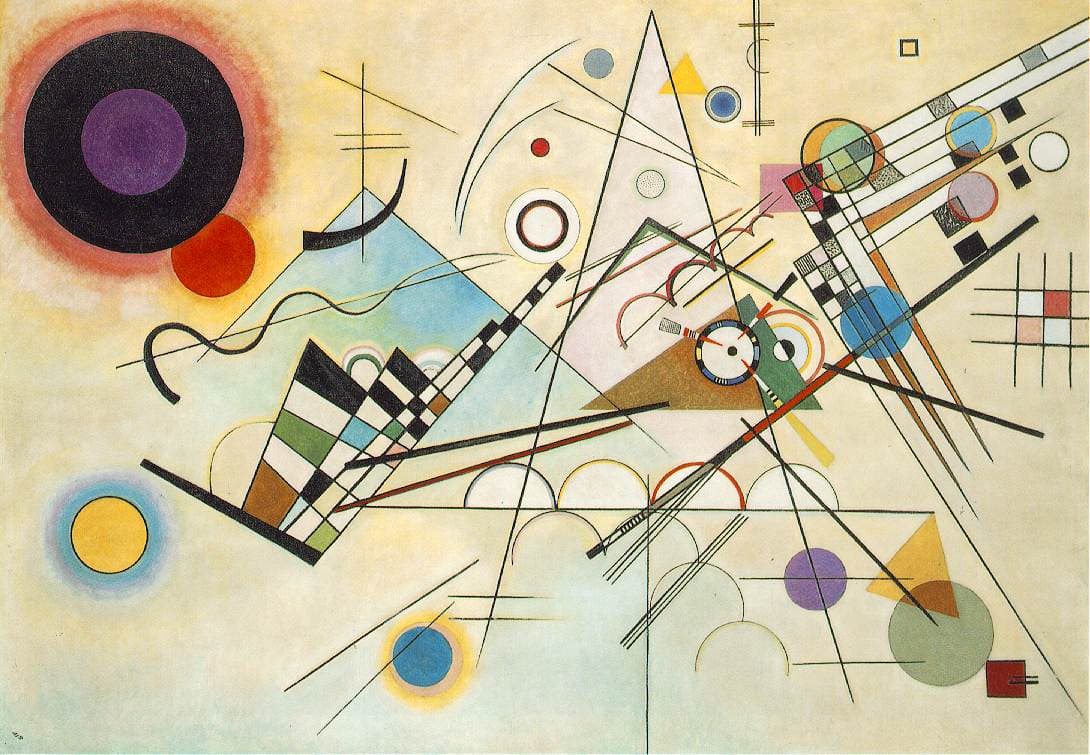
"The painting is divided into two energy poles: on the left, a luminous, geometric zone dominated by yellow; on the right, a dark, organic entity dominated by blue, linked by a mediating red center."
A true visual symphony, this monumental 1925 work marks the peak of Kandinsky’s Bauhaus period, orchestrating a fascinating struggle between the solar clarity of yellow and the mystical depth of blue.
Analysis
Yellow-Red-Blue is much more than a simple chromatic exploration; it is the practical application of Kandinsky’s theory of "inner necessity." Painted during his years at the Bauhaus, it reflects a search for synthesis between geometric rigor and lyrical emotion. Yellow, associated with the earth and centrifugal energy, stands here in opposition to blue, a celestial and concentric color that seems to recede from the viewer’s eye. Red acts as a stabilizing bridge, a force of balance between these two extremes.
Expert analysis reveals that Kandinsky treats forms as living entities endowed with their own sounds. For him, the triangle is inseparable from yellow (sharp energy), the square from red (stable matter), and the circle from blue (spiritual peace). However, in this canvas, he breaks his own rules to explore more complex nuances: sinuous black lines cross the colored zones, creating a musical rhythm that evokes an abstract score. It is an attempt to create a "world-image" where each element possesses its own autonomy while contributing to the overall harmony.
Although there is no religious myth in the classical sense, the painting embodies the myth of Creation through abstraction. Kandinsky considered the artist a prophet capable of seeing beyond matter. The struggle between the luminous left and the dark right can be read as an allegory of the fight between day and night, or between lucid reason and the creative unconscious. It is a modern cosmogony where colors are the deities of a universe purified of figuration.
The work also testifies to Kandinsky’s transition from an impulsive, lyrical abstraction toward a more calculated and theoretical one. Every color gradient is meticulously crafted to induce a specific spiritual vibration. The presence of hybrid forms, neither entirely geometric nor entirely organic, shows that the artist refused to be locked into a rigid system, preferring to leave room for poetic intuition within the structure.
Finally, this painting is a manifesto on synesthesia. Kandinsky was convinced that one could "hear" colors and "see" sounds. Yellow-Red-Blue should be read as a grand orchestral arrangement, where thin lines are violins and large blue masses are deep cellos. It is a total sensory experience that aims to elevate the viewer’s soul toward a metaphysical contemplation of the hidden order of the universe.
Join Premium.
UnlockQuiz
What artistic movement is this masterpiece by Kandinsky associated with?
Discover