Fauvism1905
The Joy of Life
Henri Matisse
Curator's Eye
"Notice the total break in scale between the figures: Matisse rejects a single perspective for an emotional organization of space. The fluidity of curved lines and non-descriptive colors create a purely pictorial space where time seems suspended."
A radical masterpiece of Fauvism, this modern Arcadia reinvents perspective and color to celebrate a sensual and utopian harmony. It is Matisse's bold response to the pastoral tradition, paving the way for Picasso's Cubist revolution.
Analysis
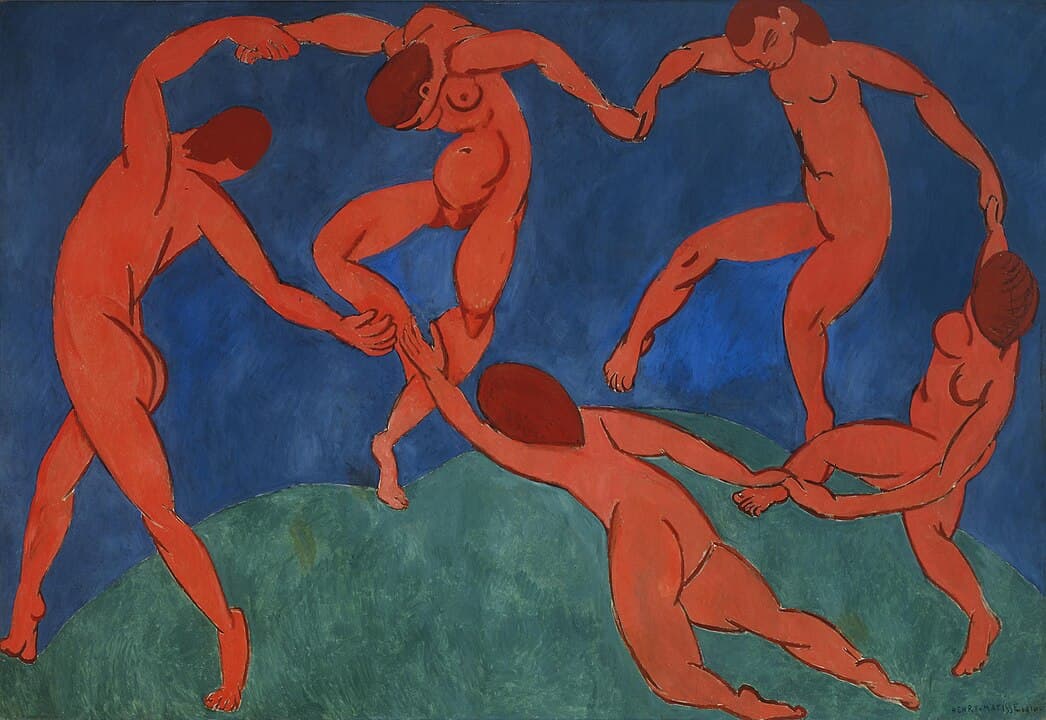
The analysis of this work reveals a bold attempt to synthesize millennia of art history into a single vibrant surface. Matisse appropriates the myth of the Golden Age or Arcadia, a theme dear to the classical paintings of Poussin or Ingres, but he dynamites its codes. Here, nature is no longer a backdrop but an organic environment that merges with bodies. The nudes, depicted in various pleasurable activities — music, dance, embraces — are not portraits but vectors of pure emotion, freed from the constraints of academic anatomy.
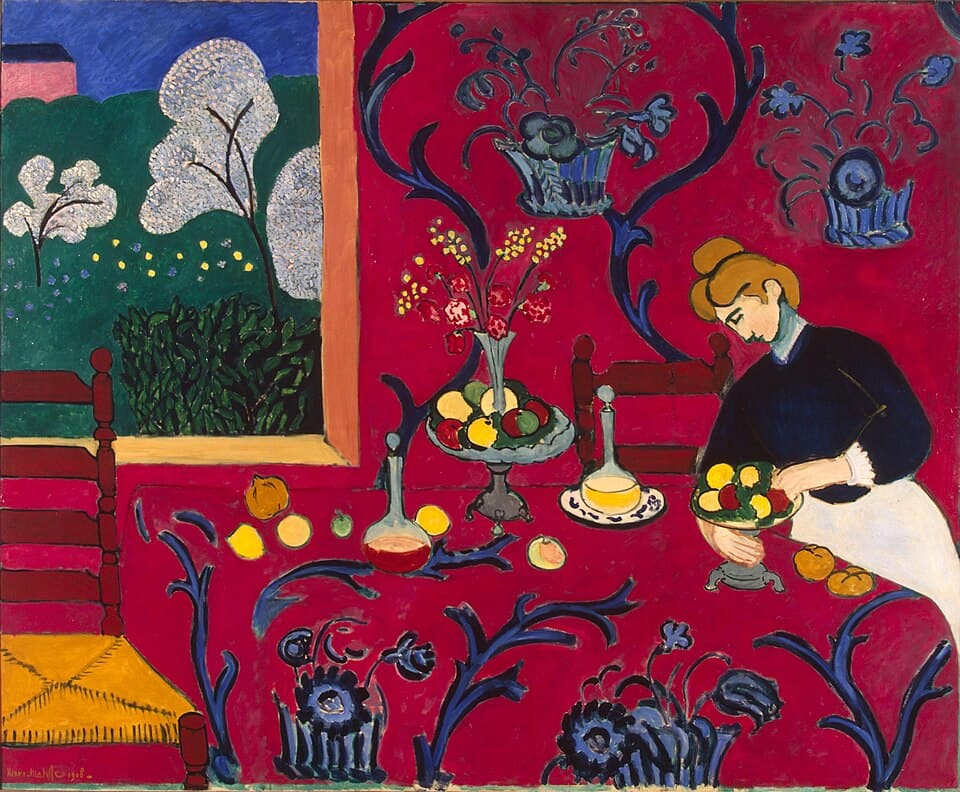
This canvas marks the peak of Fauvism through its rejection of modeling and shadow. Matisse uses flat areas of arbitrary color: trees are purple or red, the ground is a brilliant solar yellow. This "liberation" of color means the artist does not paint light as it hits objects but creates his own internal light through the juxtaposition of tones. It is a space where sensation takes precedence over representation, a direct transition toward the abstraction that would dominate the 20th century.
The link with the myth is essential: it is a return to primordial innocence, a response to the rapid industrialization of 1905. Matisse proposes a visual refuge, a "Joy of Life" that is also a political statement on the freedom of the body and the senses. Each group of figures seems to evolve in its own temporal dimension, linked to the others only by the arabesque of lines that run through the composition like an uninterrupted vital flow.
Finally, the historical importance of this work cannot be overstated. When it was exhibited at the Salon des Indépendants in 1906, it caused an earthquake. It was perceived as an insult to tradition, but for the young avant-garde, it was a revelation. It redefined the role of the painter no longer as an imitator of nature, but as a creator of worlds. Without this canvas, the dialogue between color and form would never have reached this level of radical freedom.
Join Premium.
UnlockQuiz
On a technical and iconographic level, how does Matisse justify the use of loose arabesques and the radical distortion of scales in this work?
Discover