Renaissance1515
Vanity
Titian
Curator's Eye
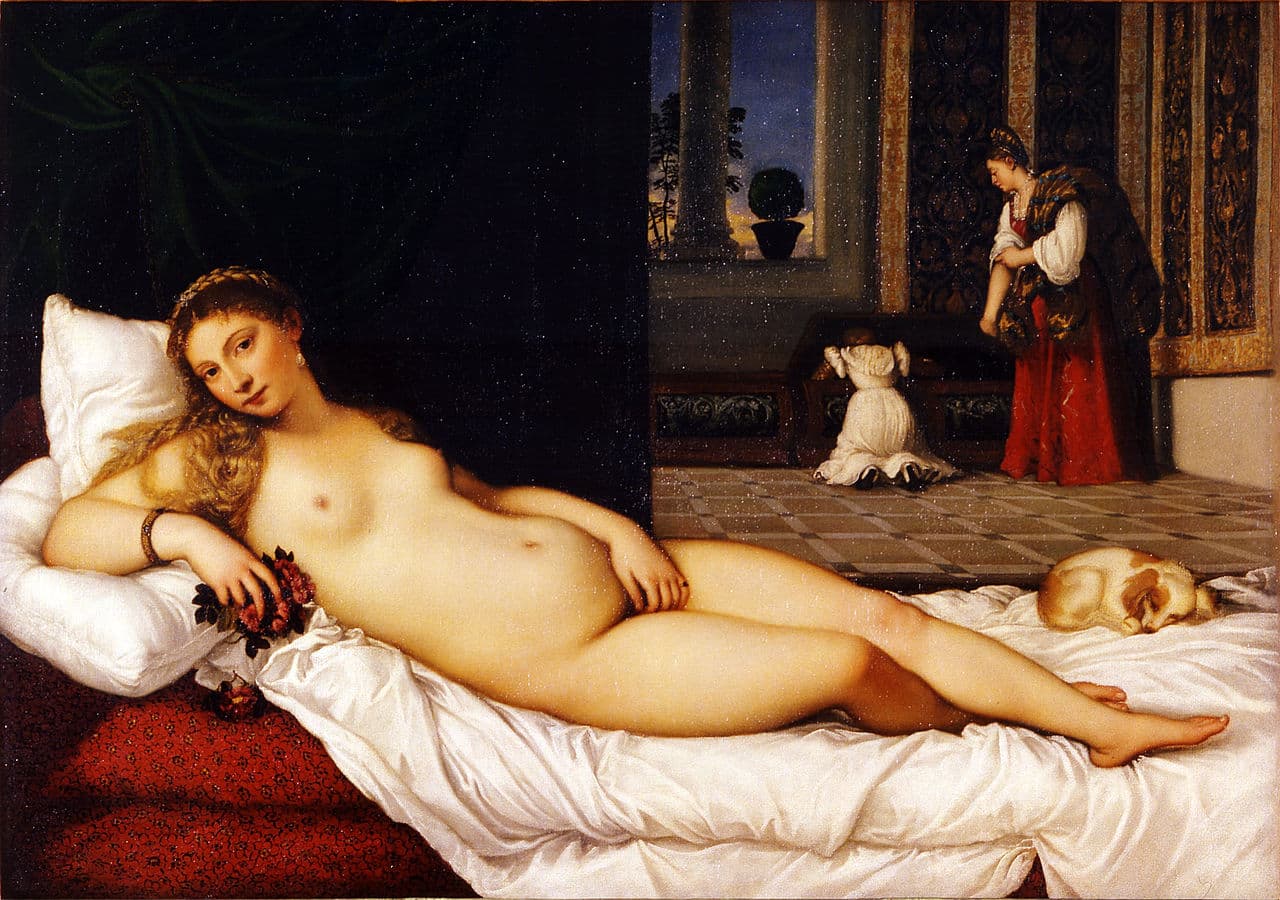
"A masterpiece from Titian's youth, this canvas illustrates the transition toward Venetian "colorito," blending subtle eroticism with moralizing symbolism typical of Renaissance humanism."
A sumptuous meditation on the fleeting nature of beauty and life, where Titian uses a mirror's reflection to confront carnal brilliance with the inevitability of death.
Analysis
This work belongs to the tradition of Venetian "Belle Donne," yet it transcends a simple portrait of ideal beauty to become a moral allegory. The young woman, with exquisitely soft features and pearly skin, embodies earthly splendor. However, the mirror she holds, supported by a dark figure in the shadows, reflects not only her jewels or face but objects symbolizing the passage of time, such as extinguished candles or coins, reminding us that neither wealth nor beauty is eternal.
Iconographic analysis reveals a tension between desire and finitude. Titian does not paint a macabre vanity with skulls, as would be fashionable in the following century, but uses a more subtle, psychological approach. The woman's gaze is melancholy, turned toward an invisible point, suggesting introspection about her own condition. The contrast between her luminous skin and the dark background accentuates this fragility of human existence in the face of nothingness.
Titian's technique here was revolutionary for 1515. He moved away from the linear precision of his masters toward an approach where color defines form. The gradients of white in the shirt, the reflections in the Venetian hair, and the texture of the velvet are rendered through layers of glazes that give the canvas a tactile depth. This sensuality of the material is paradoxical: it celebrates touch even as the subject deals with the disappearance of the flesh.
In the context of the Venetian Renaissance, this painting was intended for an intellectual elite capable of decoding double meanings. The presence of the servant, or the companion in the shadow, could be an allusion to profane love, but his role as the holder of the mirror transforms him into an agent of truth, the one who forces us to see beyond appearances. It is a transitional work, marking the move from Giorgione's influence toward the more dramatic and free style that would make Titian famous.
Finally, the work raises the question of the model's identity. Although she resembles the famous "Flora" or the "Woman with a Mirror" in the Louvre, she should not be seen as an individual portrait but as an ideal type. She is the incarnation of "Beauty" confronted with its own end, a reflection on art itself which, while it can immortalize features, cannot prevent the actual aging of the flesh.
Join Premium.
UnlockQuiz
What singular technical innovation did Titian use in the preparation of the flesh tones in "Vanity" to enhance their internal glow?
Discover