
The Great Earthquake: When Man Pierced the Golden Wall
Imagine a world where space does not exist. For 1,000 years during the Middle Ages, painters did not seek to represent reality, but Heaven. This is why they used gold backgrounds: gold is not a color, it is a material that nullifies depth. In a medieval painting, if one character is larger than another, it is not because they are closer, but because they are more religiously important. This is 'spiritual perspective': the sky is flat, eternal, and the viewer remains at the threshold of the work, as if before a sacred mirror.
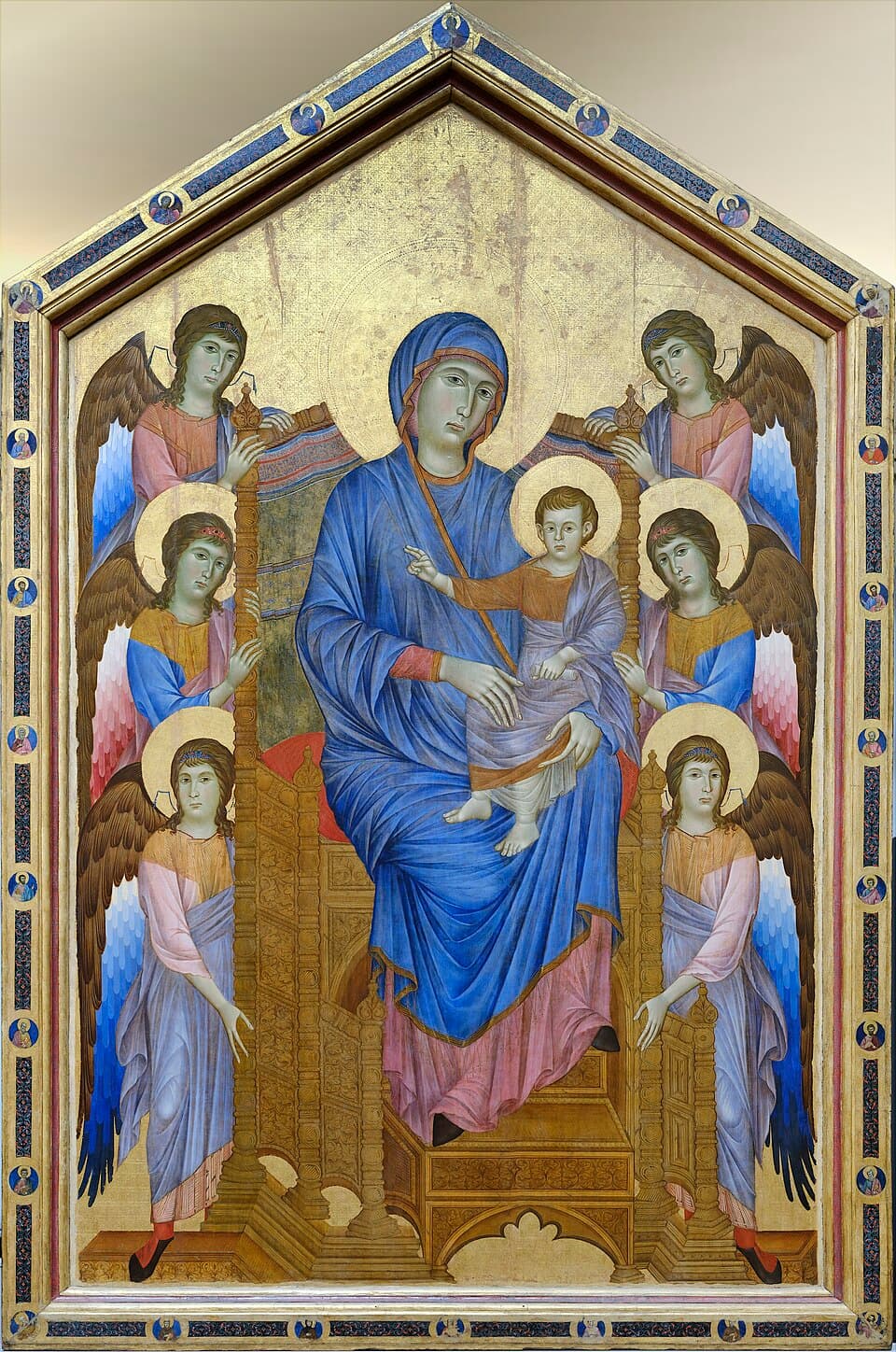
Look at Cimabue: the angels are stacked like plates, weightless. The Virgin's throne floats. There is no air, no ground, only the divine.
Then, in 1428, everything changed. In Florence, a 27-year-old painter named Masaccio created a fresco that would traumatize his contemporaries: 'The Trinity.' For the first time in human history, mathematics was used to simulate a hole in the wall. Masaccio no longer painted on the surface; he painted 'behind' the surface. By drawing lines that converge at a single point (the vanishing point), he created a 3D chapel so realistic that people at the time believed the church had been enlarged.
The shock was total: for the first time, God was subject to the same physical laws as us. He exists in a measurable, geometric, human space.
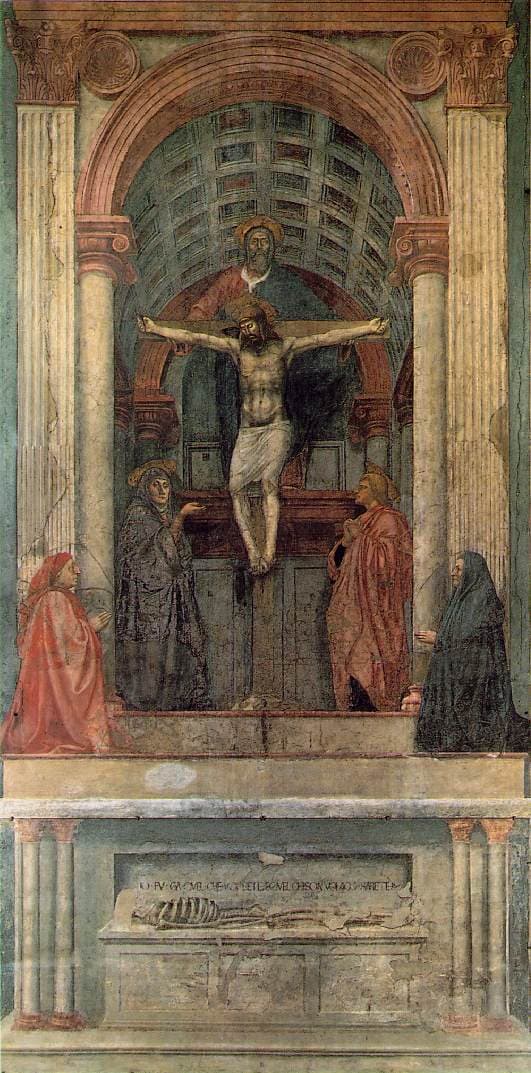
Analyze the ceiling: Masaccio draws coffered panels that shrink with surgical precision. Christ is no longer a flat icon; he has a body that carries weight.
This revolution radically changed our place in the universe. Looking at a painting became a physical experience. We moved from 'I believe' (Middle Ages) to 'I see' (Renaissance). The painter became an architect of illusion. In this lesson, we will see how this conquest was achieved through three tools: Perspective (to build the theater), Anatomy (to create the actors), and Sfumato (to add atmosphere and mystery).
Painting is a mental thing.
Prepare to change your perspective. We are leaving frozen icons behind to enter a world where light has a source, muscles have a function, and space finally belongs to the one who views it.