
Perspective: The Invention of the Modern World
If Humanism was the spiritual engine of the Renaissance, linear perspective was its technical and scientific engine. Until the beginning of the 15th century, painting remained trapped in an approximate and often clumsy intuition. Artists knew instinctively that distant objects should appear smaller, but they were ignorant of the exact mathematical law governing this diminution in space. The result was a 'stacked' or 'wobbly' space (characteristic of Byzantine and Gothic styles), where architectures seemed to collapse toward the viewer and where characters possessed neither real weight nor anchoring to the ground. The image was not a place to enter, but a two-dimensional surface of symbols to be deciphered, where a man's size depended on his religious importance rather than his position in space.
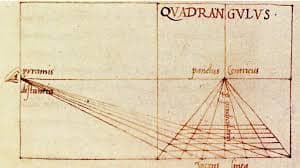
Alberti's Visual Pyramid: A geometric revolution. The real world (right) is projected toward the eye (left), creating a cone of vision that the painting intersects.
Look closely at the diagram above: it illustrates the fundamental discovery of Leon Battista Alberti. In his treatise 'De Pictura' (1435), he defined painting for the first time as a 'section of the visual pyramid.' Imagine that your gaze projects rays toward an object: the set of these straight lines forms a pyramid whose single apex is your eye. The painting is then no longer an opaque wall, but a transparent pane of glass — an open window (finestra aperta) — placed between you and the world. By precisely marking each point where a light ray crosses this glass, the artist no longer merely draws an impression; he performs a rigorous and infallible geometric projection of physical reality. It is the transition from craftsmanship to pure science.
This mathematization of space is an unprecedented philosophical takeover: by imposing a single vanishing point strictly aligned with the human gaze, the artist declares that man is the center, the witness, and the measure of all things. The chaos of the visible world is finally tamed by logic and reason.
This revolutionary theory finds its source in the spectacular experiment conducted by architect Filippo Brunelleschi in Florence around 1415. To prove the accuracy of his calculations, he painted the Baptistery of Saint John on a wooden panel, drilled a peephole in it, and used a mirror to compare his painting to the real monument from the same angle. The illusion was so perfect that it marked the point of no return for Western art: pictorial space became an extension of the physical world. From then on, the painter had to master 'orthogonals' (vanishing lines) and the horizon line to ensure the absolute coherence of his staging. The artist thus became a geometer capable of constructing a coherent universe even before placing his first character in it.
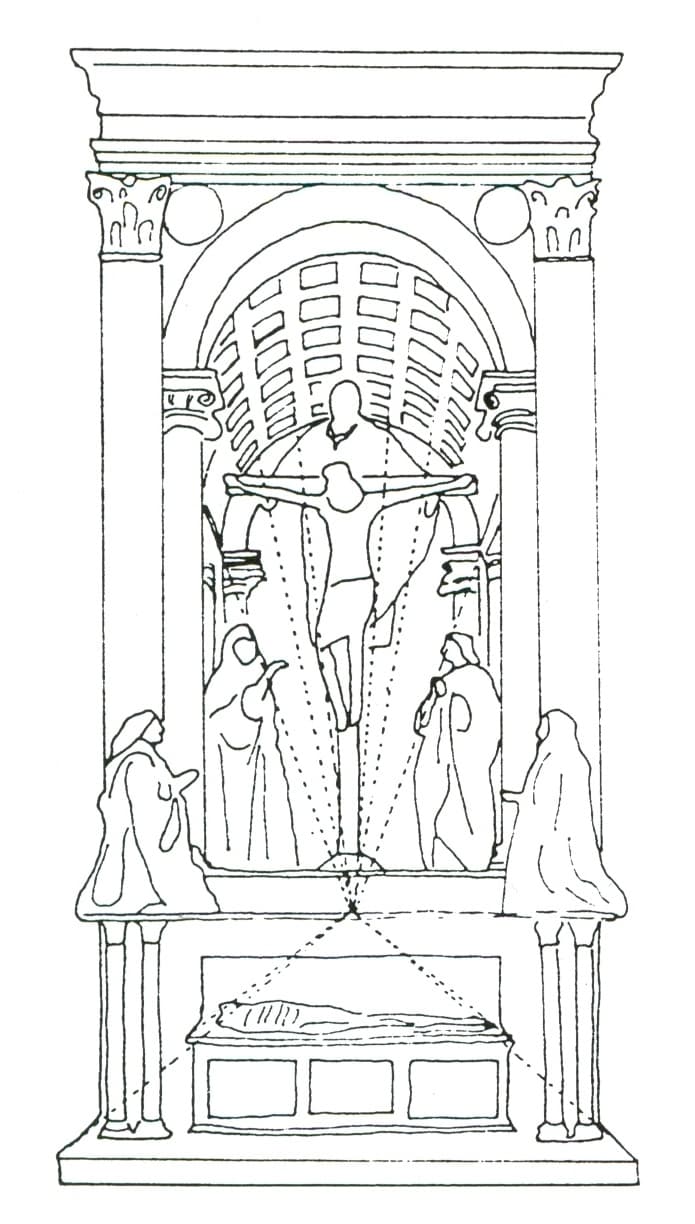
Schematic analysis of The Trinity: The dark dotted lines reveal the invisible geometric skeleton that organizes the depth of the vault, forcing the eye to converge toward a single point.
The most radical and famous application of this science is undoubtedly Masaccio's fresco, 'The Trinity,' painted in 1428. Observe in the schematic analysis above how the dark guide lines converge with millimeter precision toward a central point located at the foot of the cross. Masaccio deliberately placed his vanishing point at the floor level of the painted chapel, which corresponds exactly to the average eye height of a spectator standing in the church (about 1.60m). Why this specific technical choice? To create a striking optical illusion: the barrel vault seems to actually recede several meters inside the stone wall. Perspective no longer serves merely to simulate depth; it becomes a tool of psychological and theological staging, physically integrating the faithful into the same architectural volume as the divine.
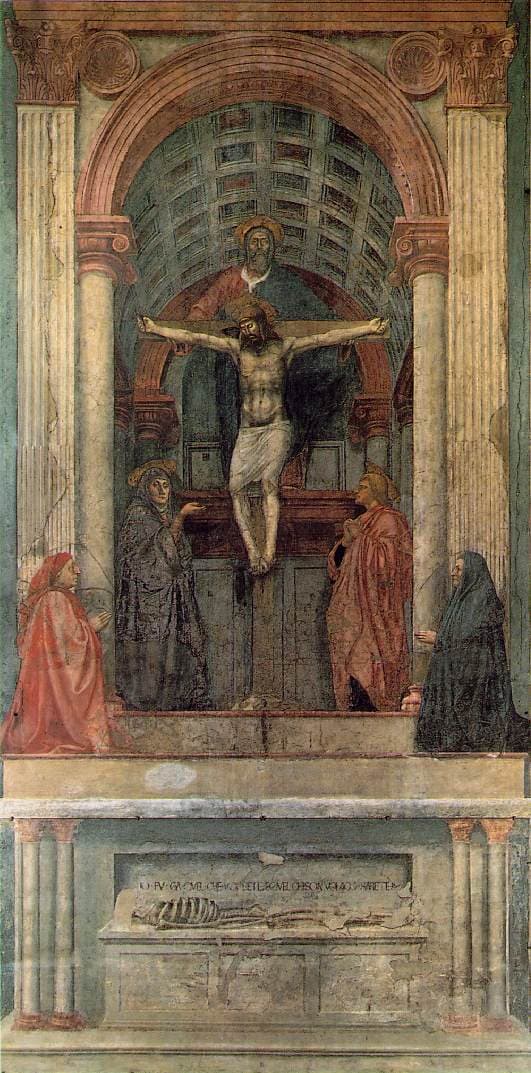
Masaccio's Trinity (1428): The final masterpiece. Here, mathematical rigor fades to give way to an architectural realism that changed the course of art history forever.
Painting is an intersection of the visual pyramid, according to a given distance, with a determined center and a fixed lighting. No one can hope to become a great painter if he does not first understand geometry, for it is the basis of all truth.
This definitive conquest of infinite space offered Renaissance artists immense creative freedom. They were no longer limited by flat backgrounds or purely symbolic landscapes. They could now orchestrate complex narratives on multiple planes, integrate grandiose architectures inspired by Antiquity, and manage crowds of characters at varying distances without ever breaking the unity of the story. The artist was no longer a simple artisan decorator in the service of faith; he had become an engineer of illusion, an intellectual capable of recreating the entire universe on a simple flat surface. Perspective was henceforth the universal language of visual truth, marking humanity's entry into modernity.