
Raphael: The Divine Synthesis and the School of Athens
We are now at the heart of the 16th century, in the early years of Julius II's papacy. In Rome, the art world is experiencing a moment of absolute grace, a suspended window of time that historians call the 'High Renaissance'. If Leonardo was the restless spirit, the scientist with unfinished research, and if Michelangelo was brute force, the tormented soul sculpting the struggle of spirit against matter, Raphael Sanzio would be the genius of the supreme synthesis. His unique talent, almost supernatural according to his contemporaries, lay in his ability to absorb the revolutionary discoveries of his two rivals and elevate them to a level of balance, clarity, and serenity never equaled. Where Michelangelo saw the human body as dramatic tension, Raphael saw it as fluid grace. Where Leonardo explored the mysteries of shadow, Raphael deployed an ordered light that made the world intelligible and divine.
‘The School of Athens’ is much more than a monumental fresco: it is the visual manifesto of triumphant Humanism. Raphael achieves the impossible balance: uniting the mathematical rigor of Florentine perspective and the sculptural physical presence of Roman bodies within an imaginary architecture that seems to breathe with ancient nobility.
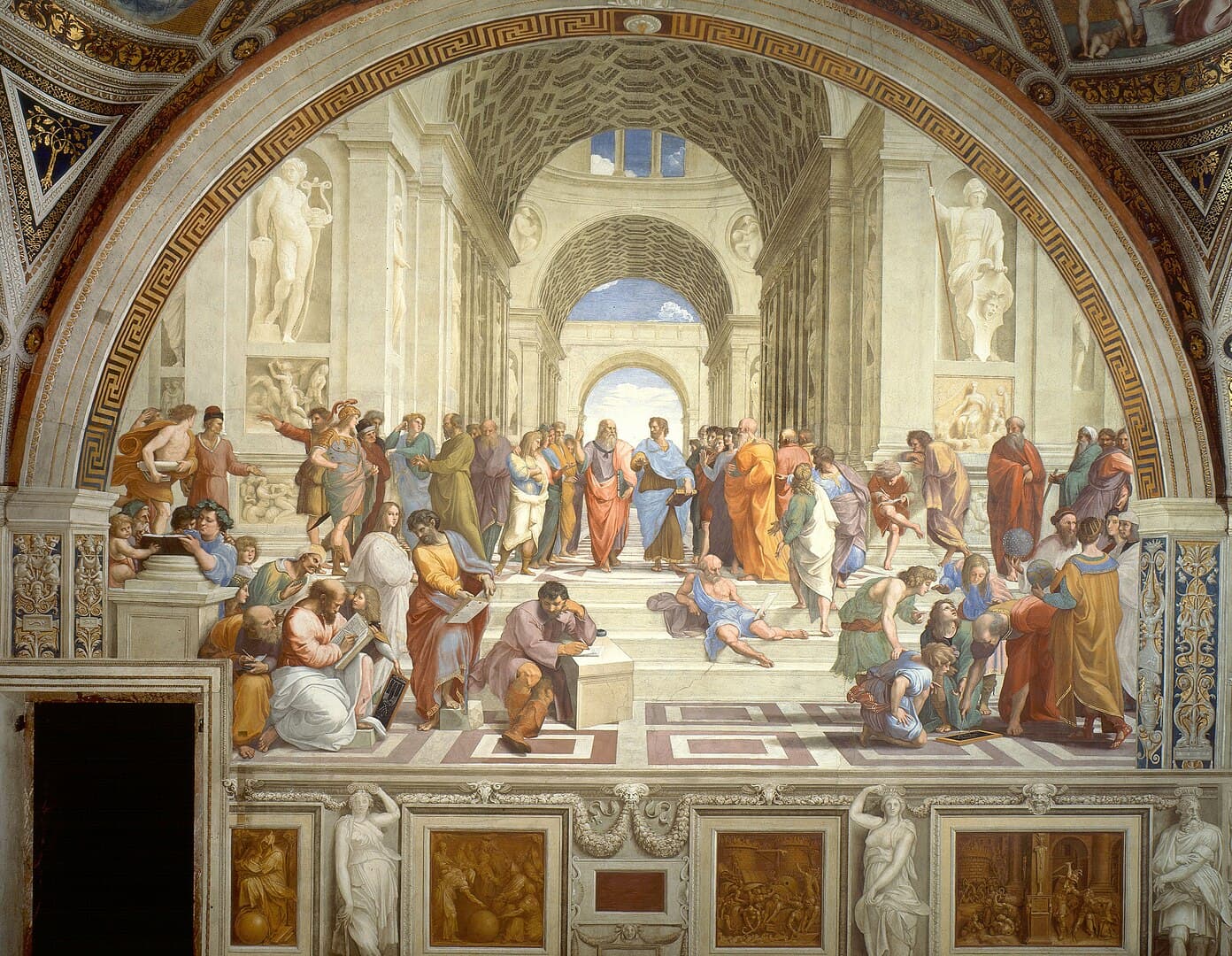
The School of Athens (Vatican): The perfect synthesis of the Renaissance. Note how Bramante's grandiose architecture serves as a setting for the gathering of the greatest minds of Antiquity and the 16th century.
Observe the masterful structure of this work. Raphael uses an architectural perspective so deep and exact that it seems to pierce the real wall to extend the room where the viewer stands. At the center of this immense nave stand the two pillars of Western thought: Plato and Aristotle. Each man's gesture summarizes a lifetime of philosophy: Plato points his finger toward the sky (the world of Ideas, the immaterial), while Aristotle extends his hand toward the ground (the observation of the sensible world, earthly ethics). The intellectual density is such that Raphael gives these sages the features of his contemporaries: Plato has the face of Leonardo da Vinci, while the melancholic Heraclitus, seated in the foreground, borrows the features of Michelangelo. It is a total reconciliation between metaphysics, science, and art, transforming painting into visual music where each group of characters moves with organic fluidity.
Parallel to his monumental compositions, Raphael achieved perfection in his more intimate works. In ‘Madonna of the Meadow’, he managed to resolve the dilemma that had occupied painters for a century: how to link characters naturally while maintaining a perfect geometric structure? Here he uses the pyramidal composition inherited from Leonardo, but he removes the anxiety and dark mystery. The characters (the Virgin, the Christ Child, and Saint John the Baptist) are inscribed in a stable triangle that brings an immediate sense of peace to the viewer. The background landscape uses the atmospheric perspective learned from Vinci, but with a luminous clarity that makes nature benevolent and serene.
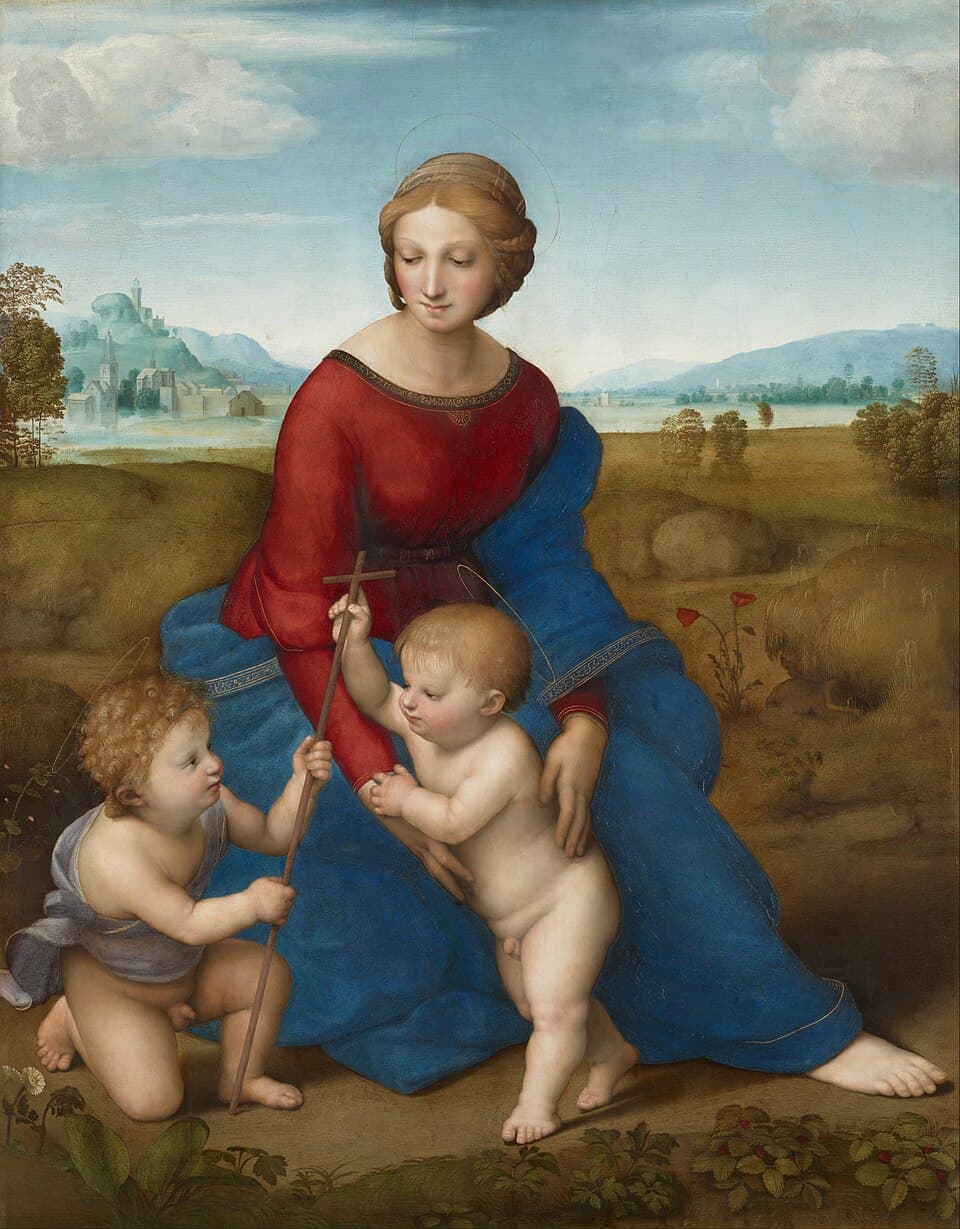
Madonna of the Meadow: Sovereign balance. The pyramidal structure ensures stability, while the softness of the faces embodies the 'grace' unique to Raphael's style.
To understand Raphael's perfection, one must grasp the concept of ‘Sprezzatura’: the supreme art of hiding effort, of making technical perfection appear as something natural and spontaneous. In his work, the line is of absolute purity, enveloping the flesh with divine tenderness without ever appearing rigid. By achieving this miraculous balance between form, substance, and emotion, Raphael nevertheless closed a door behind him: he brought the language of the Renaissance to such a point of completion that it seemed impossible to do 'better'. He created a canon of beauty that would remain the absolute reference for art academies for over three centuries, defining for the West what ‘Ideal Beauty’ is.
Nature created him as a gift to the world, endowed with all that modesty and goodness which are sometimes seen in those who, more than others, possess a certain nobility of humanity expressed in the brilliance of a temperament full of grace and divine harmony.
This perfection paradoxically marks the end of a cycle. Upon Raphael's premature death at only 37, art entered a period of doubt. His successors, aware that they could never surpass this solar balance, chose to deliberately break it. They would stretch proportions, twist perspectives, and use acidic colors to express a new anguish and exacerbated subjectivity. This would be the birth of Mannerism. But before this edifice of reason falters, we must validate your knowledge of this golden period where, for a few decades between Florence and Rome, Man believed he could touch eternity and divine perfection through the sole power of his reason and his brush.