
The Sfumato: Mastering Air, Shadow and Mystery
At the dawn of the 16th century, Italian painting had reached a technical perfection that was almost intimidating. Thanks to the geometry of perspective and the rigor of anatomy, Quattrocento masters like Mantegna, Botticelli, or Pollaiuolo knew how to build solid worlds and bodies of sculptural power. However, an invisible obstacle remained: the rigidity of the contour. In their works, lines are often as sharp as scalpel cuts, isolating characters from their environment. The world seemed frozen in an artificial clarity, a kind of pneumatic vacuum without atmosphere where every object appeared cut out and pasted onto a background. This is where the genius of Leonardo da Vinci intervenes, breaking this glass frontier to introduce air and time into the image.
Sfumato (from the Italian 'sfumare', to evaporate like smoke) is the ultimate revolution in visual rendering. For Leonardo, the straight line does not exist in nature: it is an invention of the human mind. He observed that the eye never sees perfect contours, but infinitely soft transitions modulated by light and the thickness of the air.
To scientifically translate this observation, Leonardo developed the technique of glazing. Rather than mixing his colors on a palette, he superimposed dozens of layers of translucent paint, of an almost molecular fineness. Recent chemical analyses on the Mona Lisa reveal that some of these layers are only 1 or 2 microns thick (50 times thinner than a hair). By accumulating up to thirty layers of oily binder with very little pigment, he managed to drown the drawing line. The result is a chromatic vibration where shadow transforms into light imperceptibly. Look at the corners of the lips or the corners of the eyes of the Mona Lisa: it is mathematically impossible to define a boundary line. This indetermination is the key to her mystery: the face is no longer a fixed form, but a moving expression that the viewer's brain must complete.
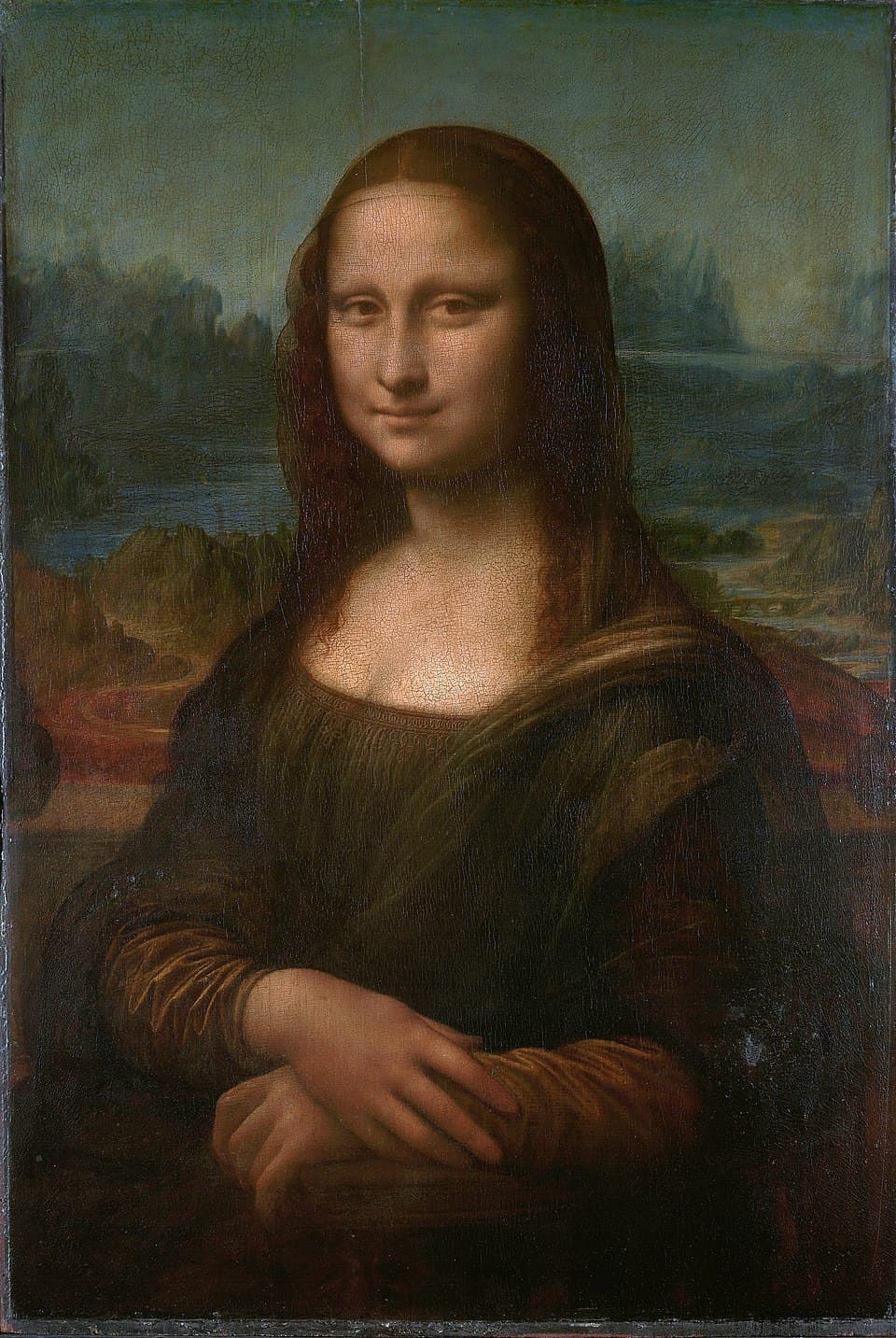
Mona Lisa: The apotheosis of sfumato. Observe how the transition from the cheek to the shadow of the temple occurs without any visible brushstroke, creating an illusion of living flesh.
But Leonardo's ambition went beyond simple portraiture; he wished to capture the entire universe through what he called 'atmospheric perspective'. He was the first to theorize that air is not a transparent void, but a physical substance charged with humidity and dust that diffuses light. The further an object moves from the viewer, the more air particles intervene, causing three phenomena: the loss of sharpness of contours, the decrease in contrasts, and, above all, a chromatic shift toward blue (the 'distance blue'). In 'The Virgin of the Rocks', the setting is no longer a decorative backdrop but a humid and vaporous ecosystem. The rocky peaks gradually fade into an azure mist, creating an infinite depth that no longer relies on cold geometric calculations, but on a poetic observation of the world's physics.
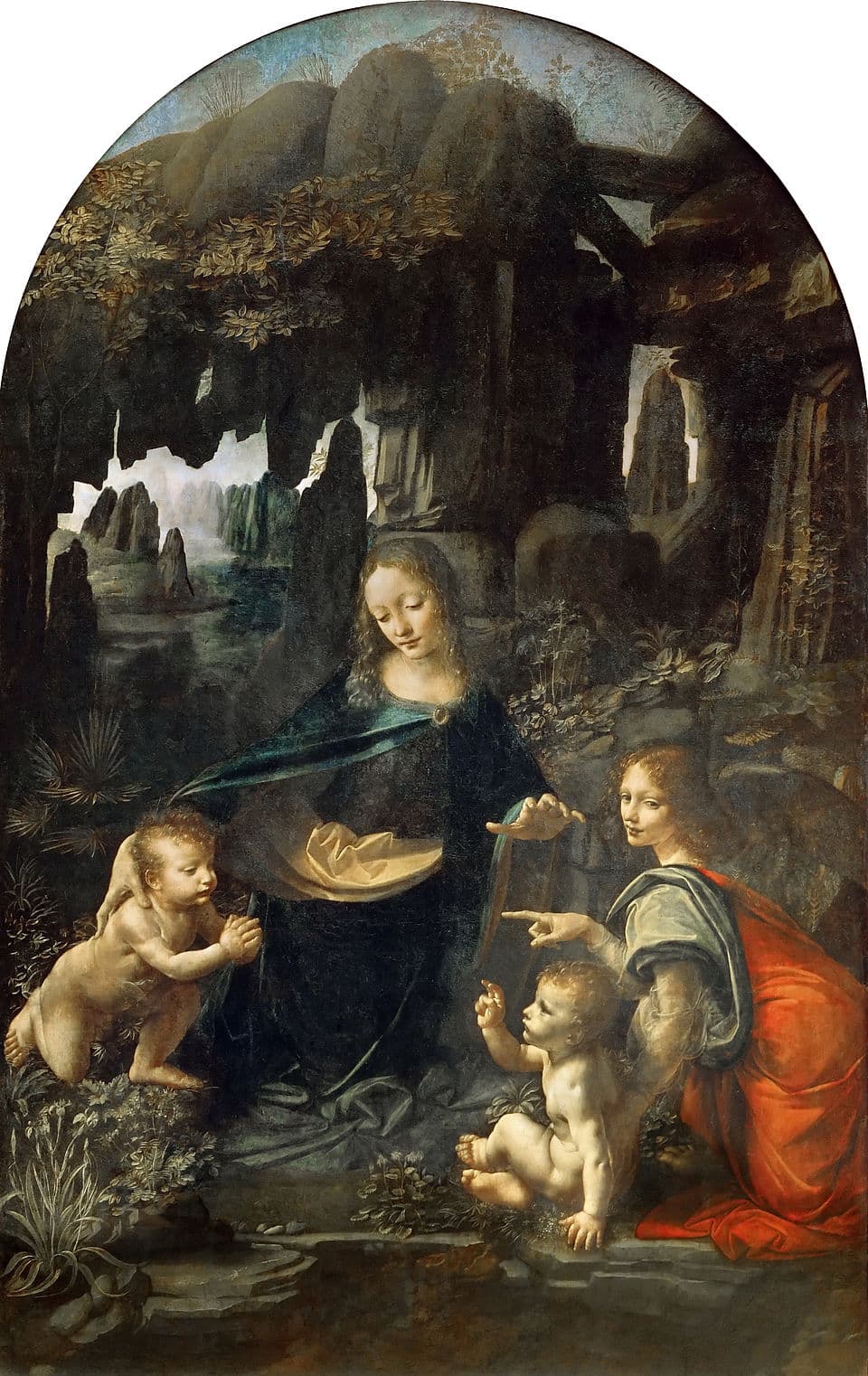
The Virgin of the Rocks: Note how the rocky landscape in the background dissolves into a bluish and misty tint. This is the birth of the modern landscape.
This mastery of the impalpable allowed Leonardo to solve one of the greatest dilemmas in painting: how to render relief without sacrificing grace? By enveloping his figures in a subtle twilight, he gave them a three-dimensional presence that seems to emerge from the darkness. In his final masterpieces like 'Saint John the Baptist', sfumato becomes almost radical: the body no longer has any borders; it is a pure emanation of light coming out of nothingness. This approach transformed the artist into a true alchemist of vision, capable of simulating not only the form of things but also the mystery of their existence. Art no longer seeks to copy nature; it seeks to reproduce the complex process of human perception.
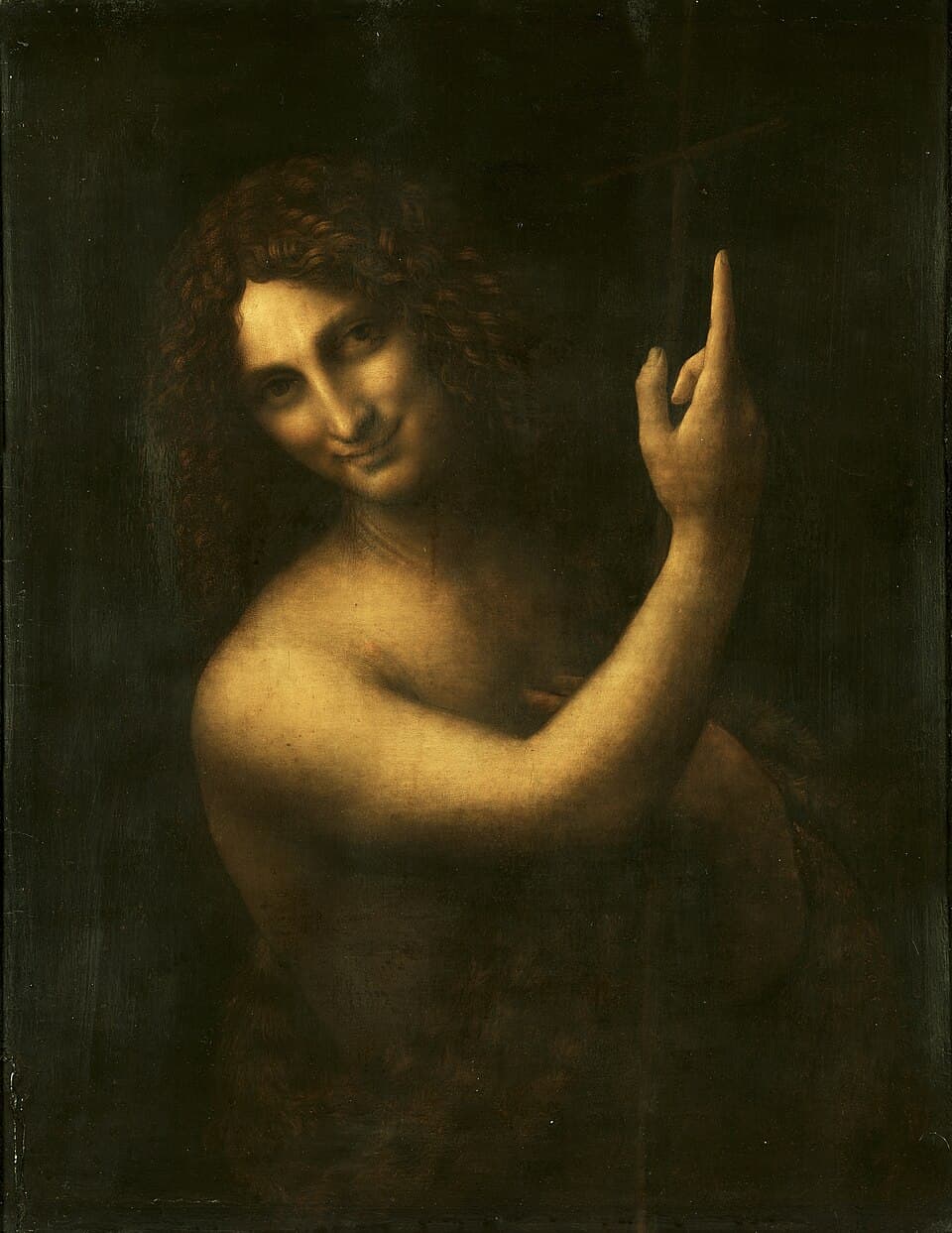
Saint John the Baptist: The ultimate demonstration of sfumato. The figure seems to extract itself from the darkness without any sharp contour, solely through the modulation of light.
Make your shadows and lights blend without strokes or lines, like smoke losing itself in the air. For light and shadow are the parents of distance, relief, and the feeling of life that animates the flesh.
This mastery of the invisible marks the pinnacle of the High Renaissance. The artist is no longer just a geometer (like Masaccio) or an anatomist (like Michelangelo); he has become a poet of shadow and light. He no longer paints only what he knows (muscles, rules), but what he feels: the impermanence of things, the movement of the air, the inner doubt. However, this Leonardesque subtlety would soon be challenged by a new ambition. In Rome, another genius, Raphael, was preparing to make the perfect synthesis of all these discoveries to reach a divine harmony, before the turmoils of history would break this precarious balance. Our next step will lead us toward the solar perfection of Raphael and the first cracks of a world already beginning to tilt toward Mannerism.